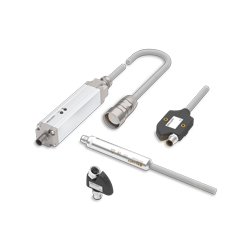
I/O Modules
Two Ways to Put Discrete Signals on IO-Link
Balluff I/O modules are IO-Link devices that gather simple on/off signals and pass them to the controller through one IO-Link master port. The range comes in two forms. Sensor/actuator hubs mount on the machine and take plug-in sensors and valves on M12 ports. Universal IO-Link interfaces have open cable leads that wire directly into existing equipment such as pumps, operator panels and valve terminals.
Manuauto is an authorized Balluff distributor in Canada and the U.S. We help you decide which module type fits each part of the machine and match it to your IO-Link master.
Hub or Universal Interface: Choose by Where the Signals Start
The deciding question is simple: are the signals coming from individual field devices with connectors, or from a piece of equipment with terminals? The table shows how the two types differ in practice.
| Sensor/Actuator Hub | Universal IO-Link Interface | |
|---|---|---|
| Device connection | M12 sockets for plug-in sensors, cylinder switches and valves | Open cable leads wired to terminals inside a device or enclosure |
| Mounting location | On the machine frame, IP67 with all ports sealed | Inside a panel, pump skid or operator station; the BNI005M is rated IP54 up to the open cable end |
| Signal count | Up to 16 points per hub | 16 PNP inputs/outputs on the BNI005M |
| Typical devices | Proximity sensors, photoelectric sensors, cylinder sensors, single valves | Pumps, signal lights, control panels, valve terminals, switching and transfer units |
| Output power | From the master port’s main supply on the models we list | Separate actuator supply through pin 2, so it needs a master port that provides actuator power |
| Product range | View IO-Link hubs | View universal interfaces |
Where a Universal IO-Link Interface Earns Its Place
Hubs are the familiar choice for sensor-heavy stations. The universal interface solves a different problem: connecting equipment that was never designed with IO-Link in mind. Four situations come up again and again:
Packaged equipment with dry contacts. A pump, chiller or dosing unit that only offers 24 V status and command signals can be wired once to the interface. One standard sensor cable then replaces the multicore cable back to the PLC.
Operator stations at the machine. Pushbuttons, selector switches and pilot lights on a local control box travel to the controller over a single IO-Link connection.
Retrofits and machine extensions. New signals can be added to an existing machine through a free master port, without installing another PLC input card or network node.
Valve terminals without a fieldbus interface. Multi-pin valve manifolds can be driven directly from the interface’s outputs.
Two installation details matter. Because the open cable end is rated IP54, the interface belongs inside an enclosure or the equipment housing, not on an exposed machine frame. And with a minimum cycle time of 4 ms, it is built for status, command and indicator signals, not for high-speed counting.
Planning the Module Count for a Machine
The fastest way to size I/O modules is to group signals by where they physically start, not by signal type. Each group becomes one module, and each module takes one master port:
List every signal by location. Separate the devices mounted on the machine frame from the equipment that has its own terminals, such as a pump skid or an operator box.
Assign a module to each group. Frame-mounted sensors and valves go to a hub. Each piece of equipment with terminals gets its own universal interface, because the short cable leads (0.5 m on the BNI005M) keep the interface close to the terminals it serves.
Count the master ports. One module per port, plus at least one free port for the next sensor or retrofit.
A typical assembly station shows how this works in practice:
| Location | Signals | Module | Master ports |
|---|---|---|---|
| Machine frame | 10 proximity and cylinder sensors, 4 single valves | 1 hub with outputs (14 of 16 points used) | 1 |
| Pump skid | 6 status and command signals | 1 universal interface | 1 |
| Operator box | 5 pushbuttons and selector switches, 4 pilot lights | 1 universal interface | 1 |
| Total | 29 signals | 3 modules | 3, so a 4-port master leaves one port free |
Without the modules, the same station would need 29 individual connections back to PLC input and output cards.
Commissioning Checklist: From First Power-Up to a Verified I/O Map
Most commissioning delays with I/O modules come from undocumented channels, not from faulty hardware. Working through these steps before the PLC program is written saves hours later:
Match each module to the right port. Universal interfaces need a port that supplies actuator power; hubs run on a standard port.
Confirm the signal logic. Make sure every connected device is PNP, matching the modules, before applying power.
Test every channel from the master. Trigger each input and switch each output from the master’s configuration tool or web interface, where available, and confirm the right device responds.
Record the I/O map. For every channel, note the port and pin or the lead color, the process-data bit it occupies and the device tag it serves. This is the document maintenance will rely on.
Label both ends of every cable with the master port and module channel.
Back up the master configuration so a replacement master can be loaded in minutes.
Every Signal on the Right Module, Every Module on the Right Port
Tell us which signals you need to connect and where they come from, and we’ll recommend the right mix of hubs and interfaces for your IO-Link master.
Frequently Asked Questions
Does a universal IO-Link interface need its own power supply?
No. The interface, its inputs and its outputs are all powered through the IO-Link cable: sensor supply on pin 1 and actuator supply on pin 2. The IO-Link specification guarantees 200 mA on pin 1, while Balluff masters supply up to 1 A, so check your master’s port ratings before you load the inputs and outputs.
Can hubs and universal interfaces run on the same IO-Link master?
Yes. Each connects to its own master port, and the master treats both as standard IO-Link devices. A single master can serve hubs on the machine frame and interfaces in nearby equipment at the same time.
Are there smaller or washdown-rated versions of the universal interface?
Yes. Balluff also offers an 8-channel version (BNI005N) and a corrosion-resistant IP69 version for food and pharmaceutical plants. Contact us for availability and part numbers.