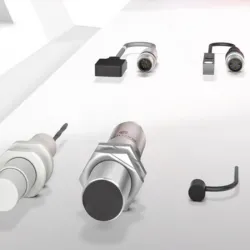
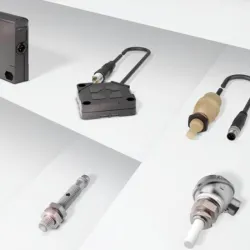
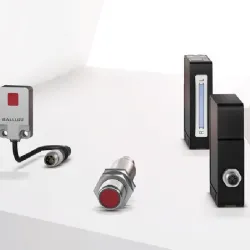
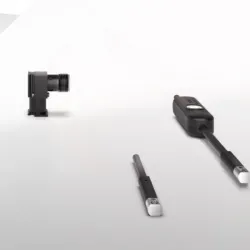
Balluff Sensor Technology
Choosing the Right Balluff Sensor Starts With the Target
Balluff Sensor Technology brings together the sensors that tell a machine what is happening: whether a part is present, where an axis is, and how far away a surface is. The right choice depends less on the sensor than on the target: its material, its distance, how fast it moves and what surrounds it. This page helps you match those conditions to a sensing principle, then go straight to the right product range.
Every Balluff sensor is tested in Balluff’s own accredited laboratory. Manuauto is an authorized Balluff distributor in Canada and the U.S., and our team can narrow thousands of variants down to the part number that fits your machine.
Sensing Principles at a Glance: What Each One Detects Best
Inductive sensors
Your taskDetect metal parts at short range
Why it worksContact-free and unaffected by oil, dust and dirt; the longest-lasting choice for metal targets
Capacitive sensors
Your taskDetect plastic, glass, wood, liquids or granulate, including through a non-metal container wall
Why it worksRespond to almost any material, not only metal
Photoelectric sensors
Your taskDetect any object over longer distances, or very small parts
Why it worksLight beams cover long ranges and resolve small targets
Magnetic field sensors
Your taskConfirm piston position on pneumatic cylinders and grippers
Why it worksRead the piston magnet through the cylinder wall
Ultrasonic sensors
Your taskMeasure distance to transparent, shiny or liquid surfaces
Why it worksSound reflects regardless of color or transparency
Radar sensors
Your taskMeasure distance through dust, fog, steam or rain
Why it worksRadar waves pass through conditions that block light
Magnetostrictive sensors
Your taskTrack the absolute position of a hydraulic cylinder or linear axis
Why it worksContinuous, non-contact measurement with no wearing parts
Cam switches
Your taskSwitch several positions along a machine axis
Why it worksMultiple switching points in one rugged housing
Condition monitoring sensors
Your taskMonitor vibration and temperature on motors and pumps
Why it worksSpot wear trends before they cause a stoppage
Balluff also builds pressure, temperature, flow and inclination sensors and encoders. Contact us for part numbers that are not listed online.
Five Specifications That Decide Whether a Sensor Fits
Once the principle is clear, these details separate a sensor that drops straight into the machine from one that has to be sent back:
Real switching distance. The rated range is measured against a standard steel target. Stainless steel, aluminum and brass reduce the usable distance of most inductive sensors, so check the correction factor or choose a sensor rated for all metals.
Housing and mounting. Thread size (M8 to M30), block or flat housings, and how much metal surrounds the sensing face all affect both the fit and the range.
Output. Switching (PNP or NPN, normally open or closed), analog, or IO-Link for measured values and diagnostics. See our Industrial Network Engineering range for the IO-Link side.
Connection. A fixed cable suits permanent wiring; an M8 or M12 connector turns a replacement into a plug-in swap.
Environment. Operating temperature, protection rating up to IP69K, resistance to coolants and cleaning agents, and immunity to welding fields.
Why Sensors Fail on the Line, and How to Specify Against It
Most sensor replacements are caused by the application, not by a defective part. Specifying for the real conditions at the start prevents the same failure from repeating:
| Cause | What you see | What to specify |
|---|---|---|
| Impact from parts or fixtures | Cracked housing, sensor pushed out of position | A longer-range sensor mounted further back, flush installation, or a protective steel bracket |
| Weld spatter and sparks | False switching, burned sensing face | Weld-field immune sensors with coated or ceramic faces and metal housings |
| Metal chips in machining | Inductive sensor triggered by a chip on its face | Mount the face vertically or downward and keep it clear with coolant or air |
| Dirty optics | Photoelectric signal fades until switching becomes unreliable | Models that report signal strength, plus lens cleaning in the maintenance plan |
| Washdown and moisture | Water ingress, fogged optics, corroded connectors | IP69K stainless housings and sealed connectors with protective caps |
Mounting Sensors Side by Side Without Interference
When sensors sit close together or face each other, one can trigger the other. The result is erratic switching that looks like a faulty sensor but disappears as soon as the neighbour is switched off. The minimum distances are in each datasheet, and the principles behind them are the same:
Whatever the principle, test the station with every sensor powered at the same time. Interference rarely shows up when sensors are commissioned one by one.
Replacing a Sensor on an Existing Machine
The fastest route to an exact replacement is the label: the order code or type designation printed on the housing or cable identifies the variant. When the label is worn or missing, these six details let us identify a compatible Balluff sensor:
Housing size. Thread size and length for cylindrical sensors (for example, M12 × 50 mm), or the dimensions of a block housing.
Sensing face. Whether the face sits level with the thread (flush) or protrudes beyond it (non-flush).
Wiring. The number of wires or connector pins and their colours. Most sensors follow the standard code: brown for +24 V, blue for 0 V, black for the switching output and white for a second output.
Switching behavior. Whether the LED lights when the target is present (normally open) or absent (normally closed), and whether the PLC input card expects PNP or NPN.
Switching distance. The distance at which the sensor switches when you bring the actual target toward it.
Photos. One of the sensor and one of how it is mounted.
Send us these details and our team will come back with a matching part number.
From Target and Environment to the Exact Part Number
Describe the target, the distance and the environment, or send us an existing part number, and we’ll match the right Balluff sensor.
Frequently Asked Questions
What is the difference between flush and non-flush inductive sensors?
A flush (shielded) sensor can be embedded level with a metal surface, which protects it from impact, but it has a shorter switching distance. A non-flush sensor reaches further but needs a metal-free zone around its sensing face.
What does “Factor 1” mean on a Balluff inductive sensor?
A Factor 1 sensor switches at the same distance for steel, stainless steel, aluminium, brass and copper. It removes the need to recalculate the switching point when the target material changes, which helps on lines that handle mixed metals.
Can a capacitive sensor detect the level in a tank from the outside?
Yes, if the wall is non-metallic, such as plastic or glass. The sensor is mounted on the outside of the wall and its sensitivity is adjusted so it responds to the contents but not the wall itself. It cannot see through metal walls.
Which photoelectric sensor type should I choose: through-beam, retroreflective or diffuse?
Through-beam sensors use a separate emitter and receiver and offer the longest range and highest reliability. Retroreflective sensors need only a reflector on the opposite side. Diffuse sensors need nothing opposite but depend on the target’s color and surface; versions with background suppression ignore objects behind the target.