
How Lanxess Canada Reached 99.98% Uptime for Remote Water Quality Monitoring
At a Glance
Lanxess Canada’s remote water quality monitoring wells in Elmira, Ontario were losing data over an aging Cisco outdoor Wi-Fi network. ManuAuto designed and commissioned a three-layer replacement: Proxim point-to-point microwave backhaul, Moxa Wi-Fi 6 access points and Moxa cellular IPsec VPN, with Modbus I/O feeding Emerson DeltaV. Network availability now stands at 99.98%.
This case study explains how separating long-distance backhaul, local field access and cellular connectivity into independent layers turned an enterprise outdoor Wi-Fi network into a monitoring network that operations and compliance teams can rely on, while the plant’s control system and core network stayed untouched.
Project Summary
- Industry
- Chemical manufacturing
- Location
- Elmira, Ontario, Canada
- Customer
- Lanxess Canada
- ManuAuto’s Role
- Surveyed the RF paths; designed the backhaul, field access and cellular layers; supplied the Proxim and Moxa hardware; installed the radios and access points; configured and commissioned the IPsec VPN links; validated Modbus data flow to DeltaV; provides ongoing remote support. Lanxess engineers configured the ioLogik I/O channels.
- System Size
- 1 central control room and 3 remote wells; point-to-point microwave backhaul, Wi-Fi 6 access at the wellheads, cellular IPsec VPN for the well without line of sight; Modbus TCP (remote I/O) → serial Modbus RS-485/422 (DeltaV)
- Solutions
- Legacy wireless migration, point-to-point microwave backhaul, industrial Wi-Fi 6 field access, secure cellular remote access, Modbus I/O integration with a DCS
- Products
- Proxim point-to-point radios; Moxa AWK-4262A; Moxa OnCell cellular routers; Moxa ioLogik E1241/E1242; Moxa MGate MB3170
- Project Duration
- Multi-phase, from site assessment to commissioning
Project Overview
Lanxess Canada operates a chemical production site in Elmira, Ontario, with groundwater and surface water monitoring wells spread across town, away from the plant and its Central Control Room (CCR). Instruments at each well measure water quality continuously, and those readings feed the site’s regulatory records and the data Lanxess shares with the community. A communications gap leaves a hole in a regulated record and usually sends a technician out to the well.
Business objectives: keep water quality data flowing to the CCR around the clock, diagnose problems remotely, let operators work from tablets at the wells, and cut site visits and unplanned outages.
Project scope: RF backhaul design between the CCR and the wells, industrial Wi-Fi at the wellheads, cellular VPN connectivity where a radio path was not practical, and integration of Modbus I/O with the DeltaV DCS.
Similar requirements elsewhere: oil and gas wellpads, municipal water and wastewater systems (wells, lift stations, reservoirs) and mining dewatering all depend on data from dispersed outdoor assets in the same way.
The Challenge
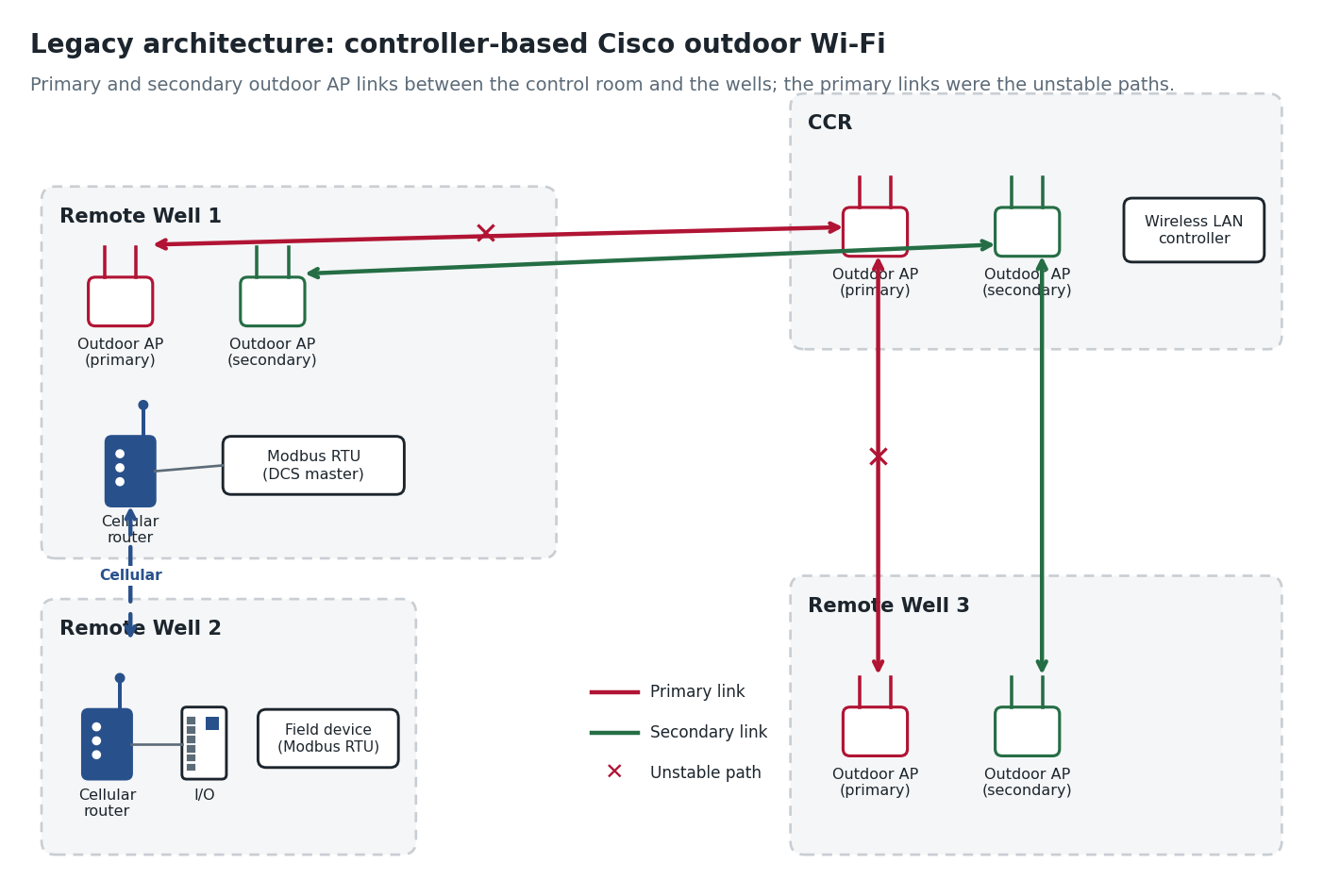
The original network used Cisco AIR-CAP1552 outdoor access points, lightweight APs that depend on Cisco 2500 Series wireless LAN controllers, with primary and secondary links between the CCR and each well. It was built for enterprise outdoor Wi-Fi, and running a continuous industrial monitoring application on it exposed three problems:
Unstable long-distance links
The longer CCR-to-well paths dropped often enough to interrupt data collection, and secure remote access to the wells was hard to keep up. Each dropout meant missing records and, often, a site visit.
Controller dependence
Every link and client relied on the wireless LAN controllers, so expanding the network or troubleshooting one well meant working through a single-vendor enterprise platform.
Ageing hardware
The outdoor APs were nearing the end of their lifecycle, and the wells needed equipment rated for years of unattended outdoor operation.
Lanxess also wanted operators to open Remote Desktop (RDP) sessions to the plant’s terminal server from tablets at the wells.
Constraints
Continuous compliance monitoring
The wells feed regulatory and community reporting, so data collection had to stay dependable throughout the change.
Existing systems stay
The DeltaV DCS and the plant’s DeltaV service network (switching, firewall, terminal server) had to be integrated, not replaced.
Dispersed outdoor sites
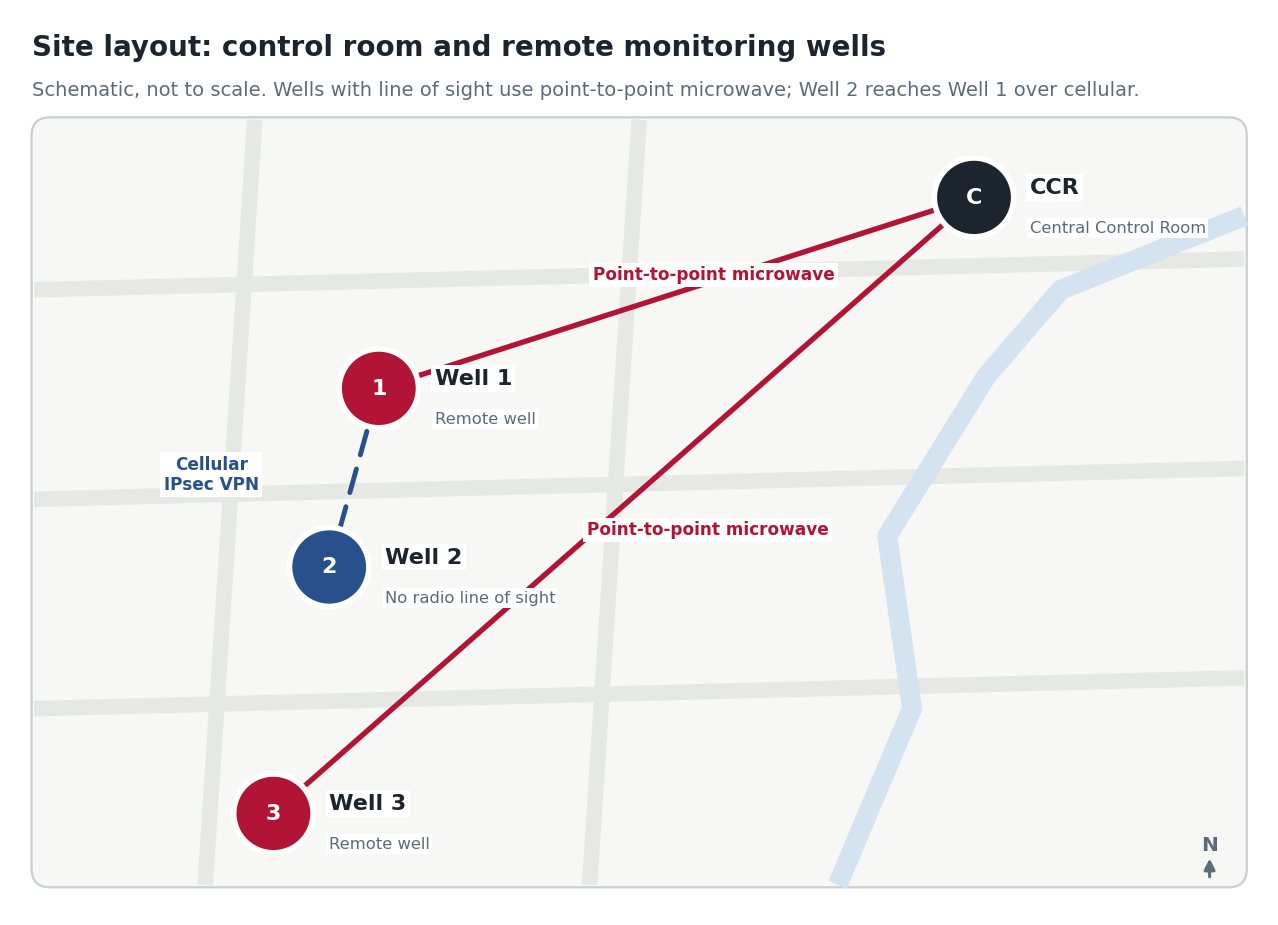
The wells sit across town, exposed to Ontario weather, and one has no radio line of sight to the network because of terrain.
The Solution
Solution strategy
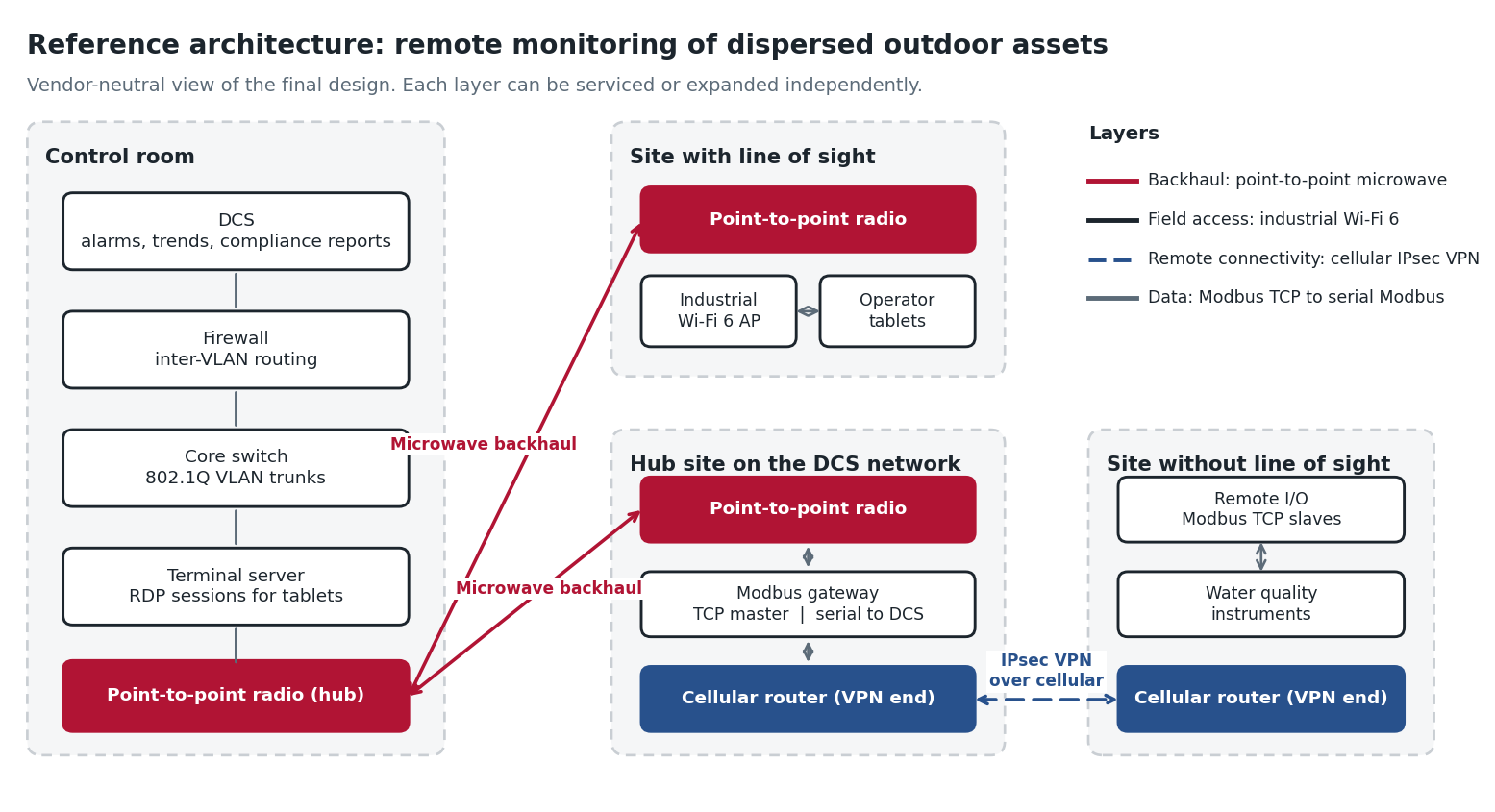
Instead of asking one controller-based WLAN to carry both long-distance transport and local access, ManuAuto gave each job its own layer. Each layer can be serviced or expanded without touching the others, and each uses the link type that suits its path: microwave where there is line of sight, cellular where there is not.
System architecture
Backhaul
Dedicated Proxim point-to-point radios replaced the legacy Cisco links as the primary transport between the CCR and the remote wells.
Field access
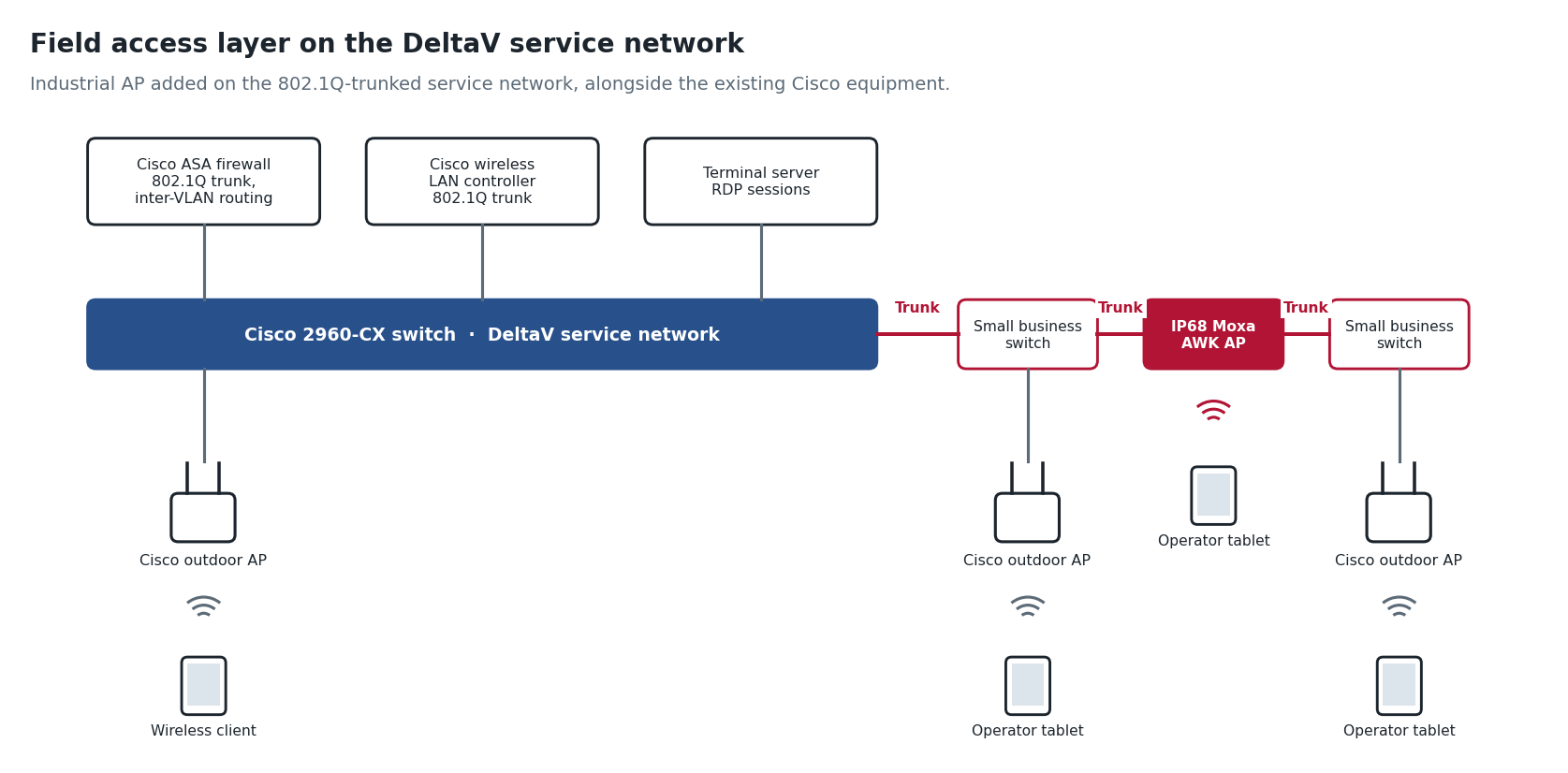
Moxa AWK-4262A industrial access points serve field equipment and operator tablets at the wellheads. They connect to the existing DeltaV service network over 802.1Q VLAN trunks and run alongside the Cisco equipment that remains in service.
Remote connectivity
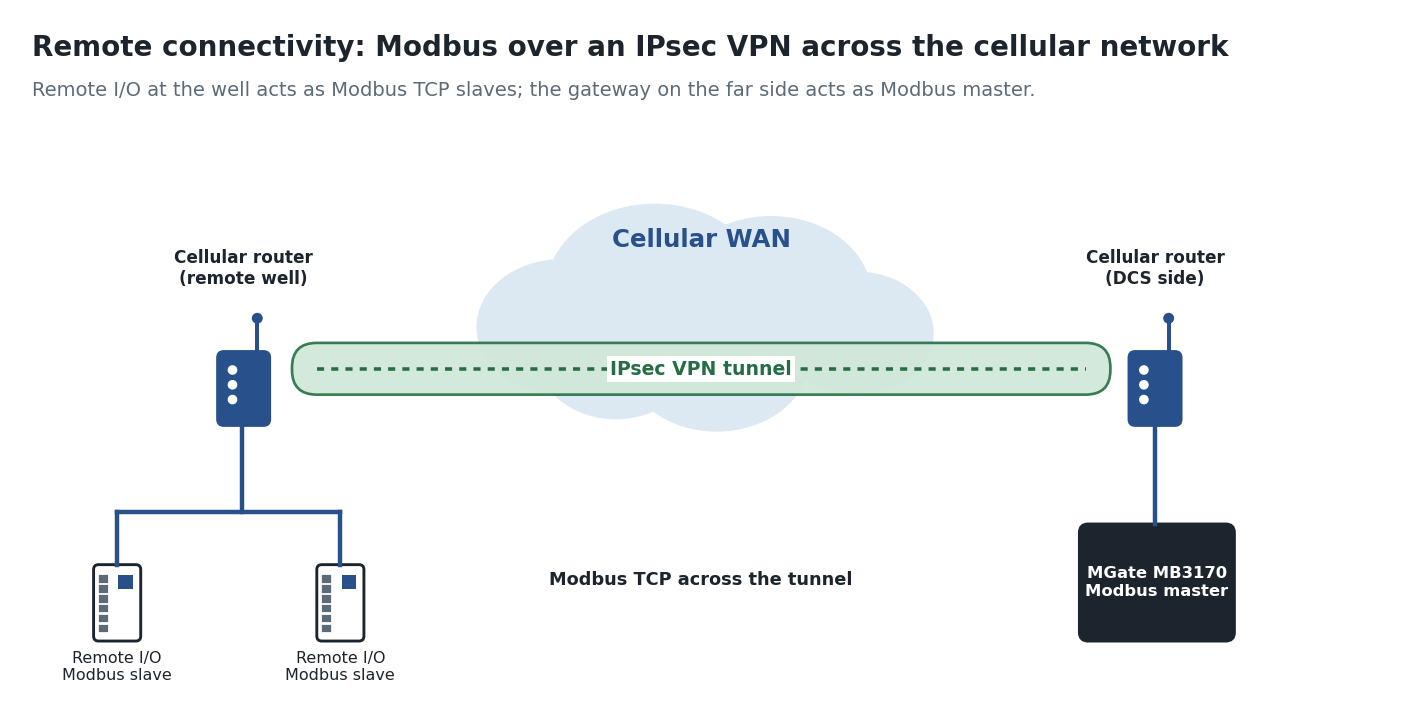
At the well without line of sight, a pair of Moxa OnCell industrial cellular routers keeps an always-on IPsec VPN tunnel across the cellular network.
Integration approach
Moxa ioLogik E1241 and E1242 Ethernet remote I/O modules collect the water quality signals and discrete status points at the wells and serve them as Modbus TCP registers. DeltaV polls over a serial Modbus link (RS-485/422 at 19200 baud, 8 data bits, even parity, 1 stop bit), and a Moxa MGate MB3170 gateway translates those requests into Modbus TCP, acting as master toward the ioLogik modules. To DeltaV, the remote wells look like any other serial field device.
Timer-based alarms on the ioLogik device uptime registers act as a communication heartbeat. If the uptime value stops updating, DeltaV raises a communication alarm for that well, so a lost link is caught immediately instead of showing up later as a flat trend line.
Migration and cutover plan
ManuAuto delivered the project in phases. The existing Cisco wireless and controller architecture was surveyed and documented first; the new backhaul, field access and cellular layers were then installed and configured, and data flow to DeltaV was validated end to end, including analog scaling and RDP access from the field, before handover.
What we reused
- Emerson DeltaV DCS, which remains the Modbus master, alarm system and reporting platform
- The DeltaV service network: Cisco 2960-CX switching, the Cisco ASA firewall and the terminal server used for RDP sessions
- Cisco outdoor access points that remain in service alongside the new Moxa APs
Security considerations
All traffic from the cellular-connected well, including remote engineering access, travels inside an encrypted IPsec VPN tunnel rather than over the open cellular network. The field access points join the DeltaV service network on 802.1Q VLANs, with routing between VLANs handled by the plant’s firewall, and operator tablets work through RDP sessions on the terminal server instead of connecting to plant systems directly.
Products and Technologies Used
| Product | Brand | Role in project | Why selected | Alternatives considered |
|---|---|---|---|---|
| Point-to-point radios | Proxim | Primary backhaul between the CCR and the remote wells | Long-distance microwave transport that runs without a WLAN controller | Keeping the Cisco controller-based links: rejected, unstable over the longer paths |
| AWK-4262A | Moxa | Wi-Fi 6 access for field equipment and operator tablets | IP68 housing, -40 to 75°C operating range, AP/bridge/client modes, backward compatible with 802.11a/b/g/n/ac clients | Keeping the Cisco AIR-CAP1552 APs: rejected, end of lifecycle and controller-dependent |
| OnCell cellular routers | Moxa | Encrypted link for the well without line of sight | Persistent IPsec VPN tunnels; static or dynamic IP on the cellular side | Point-to-point microwave: not possible, no line of sight |
| ioLogik E1241/E1242 | Moxa | Remote I/O for water quality and status signals | Analog and digital channels, Modbus TCP register map including device uptime | — |
| MGate MB3170 | Moxa | Protocol translation between the remote I/O and DeltaV | Bridges Modbus TCP devices to the DCS’s serial Modbus interface | — |
| DeltaV DCS | Emerson | Plant control, alarms and compliance reporting | Existing system, kept as the Modbus master | Existing equipment, reused |
Implementation Process
-
Site assessment
RF path survey from the CCR to each well, documentation of the existing Cisco wireless and controller architecture, and collection of the I/O and DeltaV integration requirements.
-
Solution design
Specification of the Proxim links, selection of the AWK-4262A access points and OnCell routers, and a joint definition with Lanxess of the IP addressing plan and the Modbus register usage for the ioLogik and MGate devices.
-
Installation and deployment
Microwave radios and access points installed at the wells and OnCell VPN links configured. Lanxess engineers configured the ioLogik DI/DO/AI/AO channels with ManuAuto’s support.
-
Testing and validation
Modbus communication verified, including the uptime registers; analog signal scaling validated; end-to-end data flow to DeltaV and RDP access from field tablets confirmed.
-
Ongoing support
Remote monitoring and configuration support over the VPN, including troubleshooting of ioLogik and MGate communications.
Results and Key Benefits
- 99.98%Network availability between the CCR and the remote wells
- 35%Less unplanned communication downtime, with site callouts and related labour, travel and licensing costs cut by more than a third
- 2xFaster data transfer from the remote I/O to DeltaV
- 40%Less on-site maintenance time
- ReusedDCS, plant switching, firewall and terminal server kept in service, with no control system replacement
- RemoteI/O, radios and gateways now diagnosed over the VPN instead of on site
Water quality data and alarms now reach operations and compliance teams almost without interruption. Faster links mean trends and alarms in DeltaV refresh sooner, so abnormal water conditions are spotted earlier, and engineering time that went into driving to wells now goes into optimization work.
Why This Solution Worked
Separate layers instead of one WLAN
A single controller-based network is simpler on paper, but it ties transport, access and management to one platform. Splitting them means a fault in one layer stays there, and growth is incremental: a new monitoring point needs an access point or an I/O module, not a redesign of the backhaul. The trade-off is more device types to manage, which the VPN-based remote support offsets.
Cellular where radio cannot reach
Building relay hops to bring the obstructed well onto the microwave network would have added sites and hardware. A cellular IPsec link reaches it directly; the price is a monthly data plan and higher latency, which water quality polling tolerates.
Modbus end to end
Keeping the ioLogik modules, the MGate and DeltaV on one protocol meant no middleware between the wells and the DCS and nothing new for the plant’s control team to learn. The trade-off is the throughput of serial Modbus at 19200 baud, which is ample for slowly changing water quality values.
Reference Architecture
Related Solutions and Case Studies
Frequently Asked Questions
How did ManuAuto give engineers secure remote access to the remote wells?
Through IPsec VPN tunnels between Moxa OnCell industrial cellular routers. The tunnels stay up permanently, so engineers can reach the I/O modules, gateways and radios at a well from the plant without driving out, and Modbus traffic crossing the public cellular network is always encrypted.
How did ManuAuto fix the recurring wireless dropouts between the control room and the
wells?
By replacing the controller-dependent Cisco links with dedicated Proxim point-to-point microwave radios. Each link now runs on its own, without a wireless LAN controller in the path, so a fault stays on one path and can be diagnosed directly at the radio. Network availability reached 99.98% after the change.
Can a remote monitoring network be upgraded without replacing the DCS or the plant
network?
Yes. At Lanxess, the Emerson DeltaV DCS, the plant switching, the firewall and the terminal server all stayed in service. The new wireless and cellular layers connect to the existing DeltaV service network over 802.1Q VLAN trunks, and DeltaV still reads the well data as standard Modbus registers.
Is Modbus over a cellular VPN reliable enough for DCS polling?
Yes, for process values that change over seconds or minutes, such as water quality readings. Cellular latency is higher and less predictable than microwave, so gateway response timeouts and DCS poll intervals need headroom, and a communication alarm should flag a dropped tunnel, as the uptime-register alarm does at Lanxess.