Controllers & I/Os
Industrial Controllers and I/O Modules for Plant and Remote Applications
Every decision a control system makes starts with a signal from the field. Industrial controllers and I/O modules capture those signals from sensors, switches, and actuators and pass them to your PLC or SCADA platform, whether the equipment sits in a control cabinet or at a remote site with no operator nearby.
ManuAuto carries more than 200 models in this category from Moxa and Balluff. The range runs from compact DIN rail units for crowded cabinets to Ethernet-connected modules for distributed equipment and sealed network blocks that mount directly on the machine. Customers across Canada and North America use them in manufacturing, mining, utilities, oil and gas, automotive, and energy projects to extend their industrial automation architecture.
How Controllers and I/O Work Together
The controller runs the logic. The input/output hardware acts as its eyes and hands: inputs report what is happening on the floor, and outputs carry the controller's commands back to valves, motors, and indicators.
These modules handle three kinds of signals:
- Digital: on/off states from limit switches, push buttons, and relays, plus on/off commands to contactors and solenoids.
- Analog: continuous values, typically 4–20 mA or 0–10 V, from temperature, pressure, flow, and level transmitters.
- Network data: values exchanged over industrial Ethernet with drives, smart sensors, and other controllers.
Where the hardware sits matters as much as what it reads. In a centralized design, every sensor is wired back to the main cabinet. A distributed (remote) I/O design places modules next to the machines and sends their data over a single network cable. That shortens wiring runs and makes it easier to add points later.
Which Module Type Fits Your Application
The right choice depends on four things: distance from the control cabinet, the operating environment, the protocol your controller uses, and the number of signals you need.
| Module type | Best fit | What to check |
|---|---|---|
| Ethernet remote I/O | Equipment spread across a large site or far from the control room | Channel count, network topology, daisy-chain support |
| DIN rail modules | Adding points inside an existing cabinet with limited space | Module width, supply voltage, channel density |
| Analog input modules | Process measurement that needs continuous, accurate values | Signal range (mA, V, RTD, thermocouple) and resolution |
| Machine-mount network blocks | Installation directly on the machine, with no enclosure | IP rating, M12 connectors, supported protocol |
Communication Protocols: Match the One Your Controller Uses
A module only works in your system if it uses the same protocol as your PLC or SCADA platform. The PLC brand is usually the fastest way to narrow it down:
| Protocol | Where you'll usually find it |
|---|---|
| Modbus TCP | Open and simple, supported by almost every PLC and SCADA package; a common choice for retrofits |
| EtherNet/IP | Rockwell Automation (Allen-Bradley) systems, widespread in North American plants |
| PROFINET | Siemens-based systems |
| EtherCAT | Motion and high-speed machines that need very short cycle times |
| CC-Link IE Field | Mitsubishi Electric systems |
| MQTT | Sending data to IIoT and cloud platforms rather than real-time control |
Common Applications
- Connecting sensors spread across a production floor to a single PLC
- Monitoring pumps, tanks, and substations at unmanned utility and energy sites
- Adding modern monitoring to legacy machines without replacing their controls
- Feeding condition data to predictive maintenance systems
- Giving SCADA visibility into new areas without new cable runs back to the control room
Brands We Carry: Moxa and Balluff
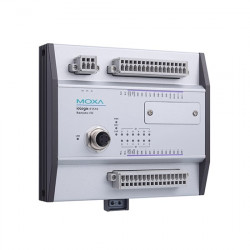
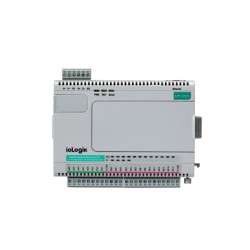
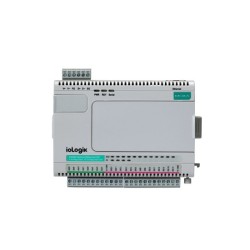
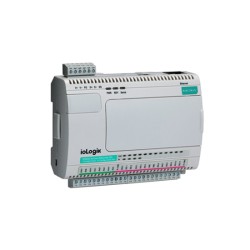
The ioLogik series covers Ethernet remote modules with digital, analog, and relay channels. The E1200 Series has two built-in Ethernet ports for daisy-chaining, supports both Modbus TCP and EtherNet/IP, and comes in wide-temperature versions for harsh locations.
Browse Moxa ioLogik products →BNI network blocks are rugged, sealed modules that bolt directly onto the machine. Sensors and actuators plug in with M12 connectors, so no cabinet is needed. Versions are available for EtherNet/IP, PROFINET, EtherCAT, and CC-Link IE Field.
Browse Balluff network blocks →When a blind spot becomes a costly problem. A remote pump is checked only during operator rounds. A pressure reading starts to drift, and nobody notices until output drops. With no history of readings, finding the cause takes far longer than it should.
A Moxa ioLogik E1200 module installed at the pump puts those signals on the network. The SCADA system then reads them continuously and raises an alarm as soon as a value leaves its normal range, well before it turns into downtime.
Controller and I/O Supplier in Canada
Spec sheets rarely tell you whether a module will work with your PLC firmware, your network layout, and the space left in your cabinet. ManuAuto's team reviews those details with you and recommends hardware that fits both the system you have today and the expansion you're planning.
Frequently Asked Questions
What protocols do industrial I/O modules support?
Most current modules support at least one industrial Ethernet protocol, usually Modbus TCP, EtherNet/IP, PROFINET, or EtherCAT, and some add MQTT for sending data to cloud platforms. Many handle more than one: Moxa's ioLogik E1200 Series, for example, runs Modbus TCP and EtherNet/IP on the same unit. Balluff network blocks are built for a single protocol each, so you pick the version that matches your controller.
Which industrial communication protocol should I choose for a new project?
If you're already standardized on one PLC brand, use its native protocol. For mixed-vendor sites, Modbus TCP is the safest common ground because nearly every device supports it. If the same data also needs to reach a cloud or analytics platform, run MQTT alongside your control protocol rather than instead of it, and use a protocol gateway wherever two systems don't speak the same language.
How do I choose the right I/O module for my PLC or SCADA system?
Work through three checks in order: the protocol your controller uses, the number and type of signals you need to connect (digital, analog, or relay), and where the module will be mounted. Leave a few spare channels for sensors you may add later. If any of these is unclear, our team can confirm compatibility before you order.
Can I add new modules to an existing PLC without replacing it?
Usually, yes. If your PLC has an Ethernet port that supports Modbus TCP or EtherNet/IP, new modules connect as additional devices on the network. Older controllers that only have serial ports can be connected through an industrial protocol gateway.
Can these modules handle outdoor or extreme-temperature locations?
Many can. Moxa's wide-temperature models (the "-T" versions) are rated for −40 to 75 °C, but they still need a protective enclosure outdoors. Balluff's sealed network blocks are designed to mount directly on equipment in dusty or wet areas.
Are Moxa controllers available in Canada and the US with fast delivery?
Yes. ManuAuto is a Moxa partner and ships ioLogik controllers and remote modules, along with Balluff network blocks, across Canada and North America. Orders over $100 ship free.