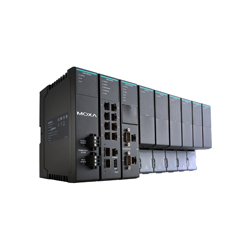
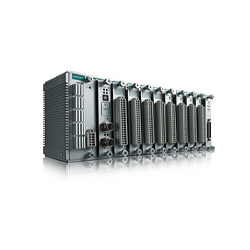
Controllers & I/Os
Moxa Controllers and I/O Put Every Field Signal Under Control
Field-level control is where industrial operations either hold together or fall apart. When a controller misses a signal or an I/O module loses connection, the consequences move fast: unplanned stops, process deviations, and maintenance calls that the right hardware, placed correctly, would have prevented.
Moxa industrial controller and I/O solutions are built specifically for these environments. They connect field devices to control systems, collect process data at the source, and support industrial edge connectivity, giving engineers the visibility and control that critical operations depend on across factory floors, remote pipeline stations, marine vessels, and everywhere in between.
ManuAuto's engineering team evaluates every product in the Moxa controller and I/O portfolio against the conditions found on real Canadian and North American industrial sites, not against a spec sheet in isolation.
What Controllers and I/O Modules Actually Do
A controller processes logic. An I/O module connects that logic to the physical world, reading inputs from sensors and sending outputs to actuators, valves, and drives. Together, they form the layer between a process and the system that manages it.
Moxa controllers and remote I/O modules handle this function in environments where standard hardware would not survive. Wide operating temperature ranges, resistance to electrical noise, and support for industrial communication protocols aren't optional features, they're the baseline specification for anything running on a factory floor, a remote pipeline station, or a marine vessel.
Without this layer, a control system is blind to what's happening in the field. With it, every signal, every status change, and every alarm condition reaches the platform that needs to act on it.
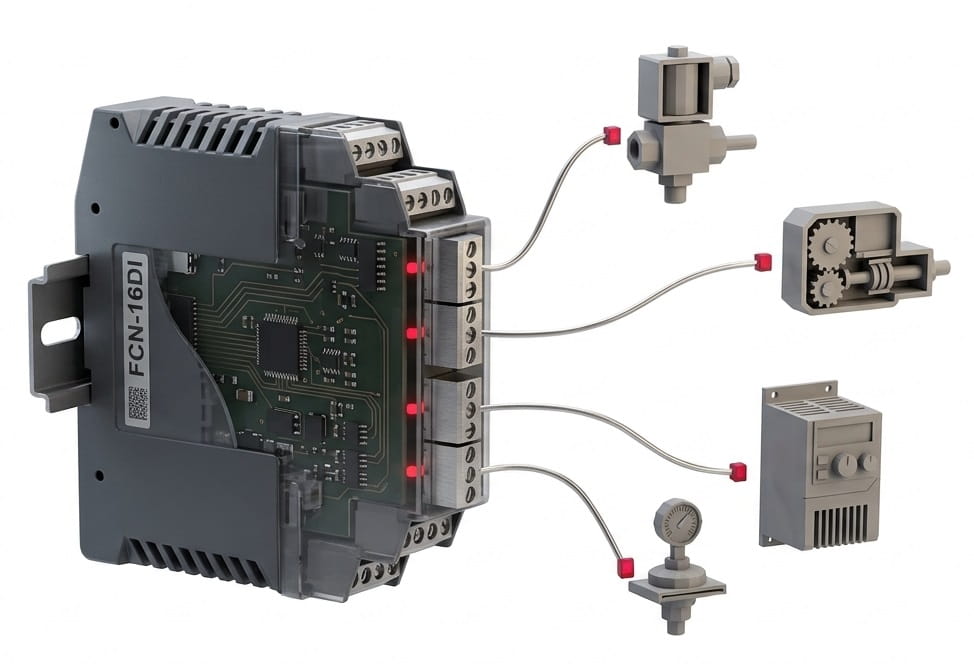
Configuration That Fits the Team on Site
Not every facility has, or wants to dedicate, a programmer to a controller deployment. Moxa's controllers support two distinct paths to get logic running, and the choice is the integrator's, not the hardware's:
Programming-free setup
Click&Go and Click&Go Plus let engineers configure control logic rules through a guided interface, without writing code.
Full programmatic control
For applications that need it, the same hardware supports C/C++, IEC 61131-3 (CODESYS), IEC 61131-3 (ISaGRAF), and Python.
That range matters when a project scope shifts mid-deployment: a facility can start with a no-code configuration and move to custom logic later without swapping hardware.
Moxa controllers and I/Os are organized into three product families, each matched to a different operational requirement:
Why Industrial Operations Rely on Moxa I/O Controllers
The problems Moxa industrial I/O hardware solves are consistent across sectors, from factory automation and power utilities to marine, oil and gas, railway and road transportation, water and wastewater, mining, and IP surveillance. PLC I/O capacity runs out as operations expand. Field devices sit too far from the control cabinet to wire directly without high cost. Process events happen faster than a polling-based system can catch them. Remote sites generate data that never reaches the control room reliably.
Moxa I/O solutions address each of these gaps directly:
Expanding PLC I/O capacity
Additional I/O nodes extend the reach of an existing controller without replacing the architecture.Acquiring field data efficiently
Distributed I/O modules collect process values at the source and route them to the control system over industrial Ethernet. For more details, explore our Moxa Remote I/O solutions guide and real-time field data acquisitionReducing factory floor wiring costs
Remote I/O placement eliminates long signal cable runs back to a central cabinet.Enabling proactive event reporting
Active reporting pushes data to the control system on change of state rather than waiting to be polled.Remote monitoring and control
Field assets at unmanned or geographically dispersed sites become visible and controllable from a central platform.
Manuauto: Your Moxa Controllers & I/O Supplier in Canada
The wrong I/O specification doesn't announce itself on a datasheet. It shows up when a module loses communication under temperature stress, or when a polling-based system misses a fast-changing process event. ManuAuto's engineering team reviews application requirements, environmental conditions, and protocol compatibility before recommending a single product, at the specification stage, not after the hardware is installed.
As an authorized Moxa controllers and I/Os supplier in Canada, ManuAuto provides verified product availability, fast distribution across Canada and North America, and post-deployment support covering configuration, troubleshooting, and long-term continuity. For engineers working with Moxa distributed I/O across Canada, ManuAuto is the local technical resource behind every order.
Frequently Asked Questions
1. What are Moxa controllers and I/Os?
Industrial hardware devices that connect field-level sensors, actuators, and equipment to control and monitoring systems. Controllers process logic and manage automation sequences; I/O modules collect input signals from field devices and send output commands back to them. Together, they form the control and data acquisition layer of an industrial network.
2. What are Moxa remote I/O modules used for?
They collect and process data from field devices, sensors, meters, switches, and route it to a PLC, SCADA platform, or IIoT application over an industrial Ethernet network. Common uses include expanding existing PLC I/O capacity, reducing field wiring costs, and enabling remote monitoring at unmanned or geographically distributed sites.
3. Can Moxa controllers be configured without writing code?
Yes. Click&Go and Click&Go Plus let engineers configure control logic through a guided, programming-free interface. The same hardware also supports full programmatic control, C/C++, IEC 61131-3 (CODESYS/ISaGRAF), and Python, for applications that need custom logic.
4. What protocols do Moxa ioLogik I/O devices support?
The ioLogik series supports Modbus TCP, Modbus RTU, EtherNet/IP, DNP3, MQTT, OPC UA, SNMP, and RESTful APIs, plus Moxa's proprietary active OPC server and peer-to-peer communication, which lets devices report data directly to other nodes or platforms without a host controller initiating the exchange.
5. How does Moxa's peer-to-peer communication reduce wiring costs?
It lets Moxa I/O devices send data directly to other I/O devices or control systems without running signal cables back to a central controller. Field devices at distributed locations exchange data over the existing Ethernet network instead, eliminating long cable runs, cutting installation labor, and simplifying the physical architecture of distributed control systems.
6. Where can I buy Moxa controllers and I/Os in Canada?
Through ManuAuto, an authorized Moxa distributor stocking the full ioLogik range and serving Canada and North America. Every order includes access to ManuAuto's engineering team for specification support, compatibility verification, and post-deployment assistance.