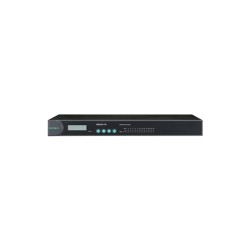
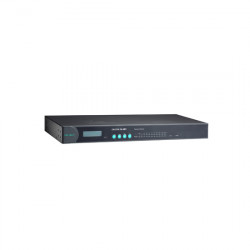
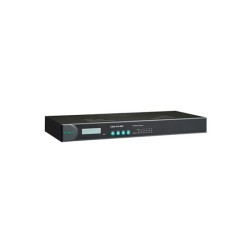
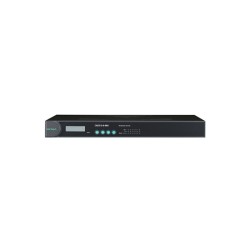
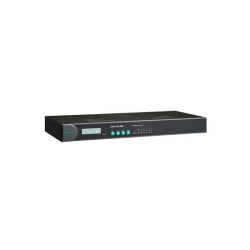
MOXA NPort 5610-8-DT Serial to Ethernet Device Server


- Model: NPort 5610-8-DT


Moxa NPort 5610-8-DT: Turn Eight RS-232 Devices Into One Ethernet Connection
A facility with eight separate RS-232 instruments doesn't need eight separate solutions to get them onto the network. The NPort 5610-8-DT handles all eight from a single compact unit, providing edge connectivity by converting RS-232 signals from every connected device into Ethernet-accessible data without touching the original hardware.
This General Device Server is the RS-232-only member of the NPort 5600-DT series, which is exactly why it gets specified over the 5650-8-DT variants: facilities running purely RS-232 equipment don't need to pay for RS-422/485 support they'll never use. It shows up often in industrial automation and manufacturing environments where legacy RS-232 instrumentation has accumulated over the years and needs a practical path onto a modern network.
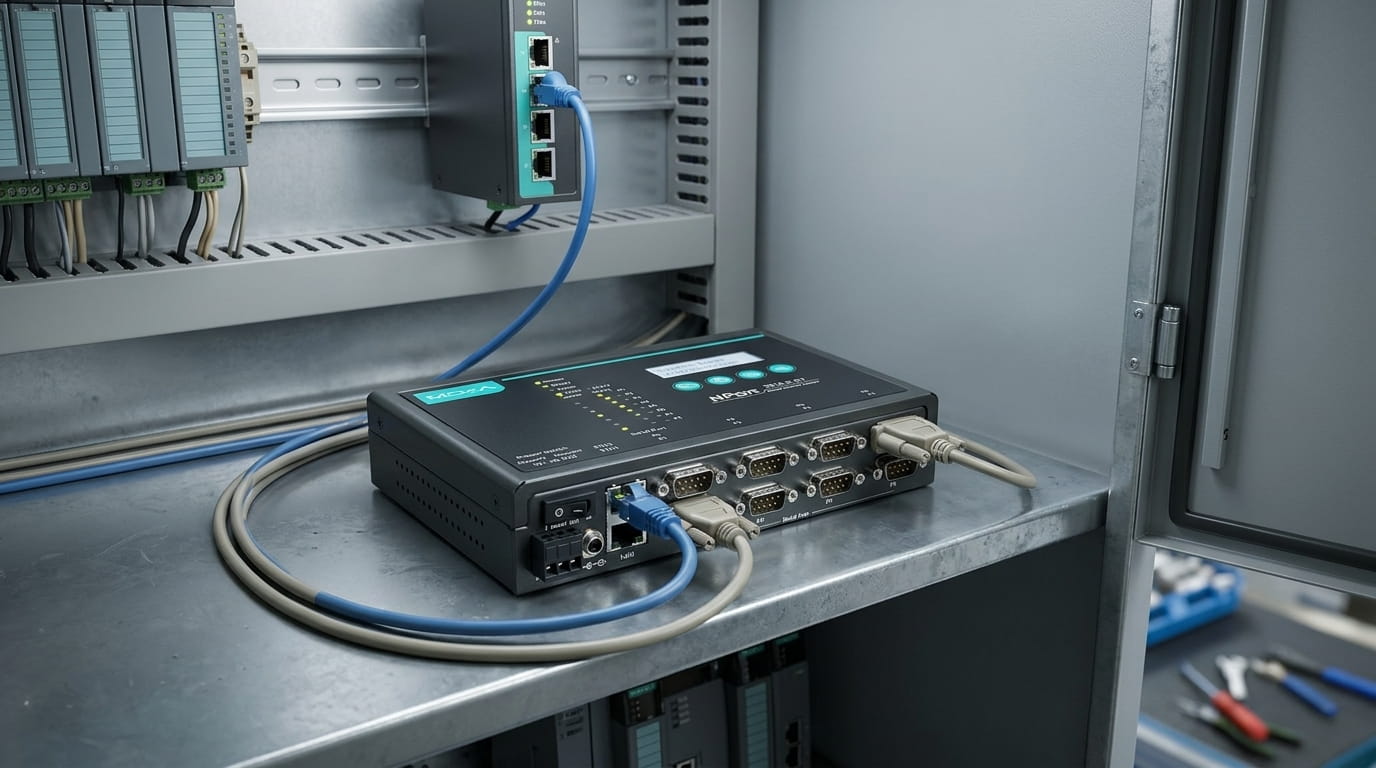
Hardware Breakdown: What's Under the Hood of the 5610-8-DT
At its core, this is an 8-port RS-232 serial device server : eight DB9 male serial connectors handling RS-232 communication exclusively, with no RS-422 or RS-485 support on this model.
Two 10/100BaseT(X) Ethernet ports carry that data onto the network, with 1.5 kV built-in Ethernet magnetic isolation protecting against electrical noise. Those two ports aren't just for show, either, they support genuine cascade wiring, so a second NPort 5610-8-DT can connect through the first unit's spare Ethernet port without pulling in an additional switch.
Dual 12–48 VDC power inputs, a terminal block, and a power jack mean a backup power source can keep the unit running if the primary supply drops. And since this is a standard-temperature model (0 to 55°C), it includes the LCD panel and push buttons for configuration, a feature the wide-temperature "-T" variant doesn't carry. The housing is metal, built for continuous industrial use rather than casual desktop deployment.
How the NPort 5610-8-DT Talks to Your Existing Software
Beyond the physical ports, the NPort 5610-8-DT runs on the same communication stack found across the NPort 5600-DT Series.
| Capability | What It Means |
| Real COM / Real TTY | Makes each of the eight ports appear as a local COM port (Windows) or TTY device (Linux) to existing software. |
| Operation Modes | Real COM, TCP Server, TCP Client, UDP, Reverse Telnet, Pair Connection, and Ethernet Modem, configurable independently per port. |
| TCP/IP Networking | Standard network-layer support, ensuring compatibility with existing Ethernet infrastructure. |
| Network Management | SNMP, HTTPS, and Telnet for standard IT-level visibility and remote administration. |
For applications running existing Windows or Linux software that expects a physical serial port, Real COM and Real TTY drivers mean no code changes are needed; the networked port just behaves like a local one. For applications built around direct socket connections instead, TCP Server or TCP Client modes handle that without the driver layer at all.
Default Login, Network Setup, and Firmware Updates
Every NPort 5610-8-DT ships with the same default static IP used across the NPort 5600-DT Series : 192.168.127.254, netmask 255.255.255.0. That IP address is visible directly on the LCD panel the moment the unit powers on, no search utility required.
Logging in uses the default account admin and password moxa, and that password should be changed before the unit goes into production use, particularly in facilities where multiple people have access to the configuration interface. Configuration itself runs through the serial console, Telnet console, a Windows utility, or the web console over HTTP or HTTPS, whichever fits how your team already manages the rest of the network.
The matching driver, Windows Real COM or Linux Real TTY, is available directly through Moxa's official support site, and installing it lets each serial port appear as a standard local port to existing applications. Updating firmware follows the standard pattern: download the current release, upload it through the web console, and the unit restarts automatically once applied. The NPort 5610-8-DT quick installation guide, user manual, and configuration guide cover all of this in more detail if you'd rather work through it directly.
Industry Certifications and Regulatory Compliance
- EN 55032 / EN 55035: Confirms EMC compliance for European markets
- CISPR 32 / FCC Part 15B Class A: Verifies electromagnetic compatibility for industrial use
- IEC 61000-4-2, -4-3, -4-4, -4-5, -4-6, -4-8, -4-11: Covers immunity testing against electrostatic discharge, radiated and conducted interference, surges, and power-frequency disturbances
- UL 60950-1 / IEC 62368-1: Confirms safety compliance under recognized industrial standards
- RoHS / CRoHS / WEEE: Confirms compliance with restricted-substance and environmental regulations
Ready to Bring the NPort 5610-8-DT Into Your Facility?
The Moxa NPort 5610-8-DT is available across Canada and North America, ready to bring eight RS-232 devices onto a single Ethernet connection. If you're not sure whether this RS-232-only model fits your equipment, or if you need the broader RS-422/485 support of the 5650-8-DT instead, our team can help confirm before you order.
Frequently Asked Questions about the NPort 5610-8-DT
1. How many serial ports does the NPort 5610-8-DT have?
Eight, each configurable independently and connected through DB9 male connectors.
2. Does the NPort 5610-8-DT support RS-232?
Yes, exclusively. This model doesn't support RS-422 or RS-485; that support is available on the NPort 5650-8-DT models instead.
3. Does the NPort 5610-8-DT support TCP/IP and UDP?
Yes, alongside Real COM, TCP Server, TCP Client, and several other operation modes.
4. Does the NPort 5610-8-DT support Real COM?
Yes, Real COM mode makes each networked serial port appear as a local COM port to existing Windows software.