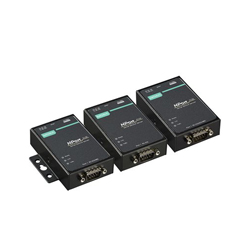
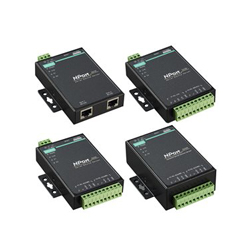
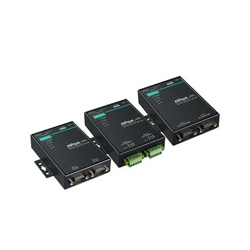
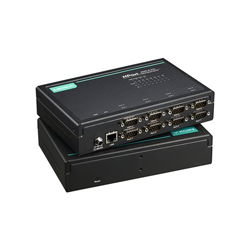
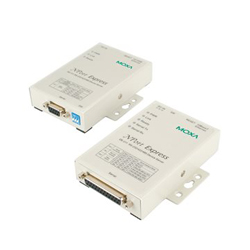
General Device Servers
Moxa General Device Servers Bring Serial Equipment Into Modern Networks
A serial device doesn't ask permission before it stops fitting into your network plans. It just sits there, still working perfectly, while everything around it moves to Ethernet. That's the exact gap Moxa General Device Servers were built to close, turning RS-232, RS-422, and RS-485 signals into something your modern network can actually use.
You'll find these device servers earning their keep across manufacturing floors, oil and gas facilities, energy infrastructure, water and wastewater plants, mining operations, railway networks, marine systems, and factory automation lines. Wherever legacy serial equipment refuses to retire, there's usually a Moxa NPort device server quietly bridging the gap.
What a General Device Server Actually Does
Strip away the branding and a general device server does one job well: it takes serial data and makes it Ethernet-ready. No firmware rewrite, no swapping out working hardware, just a straightforward conversion that lets old equipment join a new conversation.
That simplicity is precisely what makes it useful in so many places. A PLC that's been running on RS-485 since before anyone in the building today was hired, a meter that only speaks RS-232, a controller wired for RS-422 decades ago, all of it can suddenly report back to a centralized network without anyone touching the original device.
Why does that matter? Because the alternative, ripping out functional equipment just to modernize connectivity, rarely makes financial or operational sense. A general device server sidesteps that entire problem.

Key Features That Actually Matter in the Field
Trust in a device server comes from what it does when conditions get difficult, not from a spec sheet. Here's what separates a dependable one from a liability waiting to happen.
- Serial-to-Ethernet Connectivity: Converts serial data into Ethernet-ready traffic, giving legacy devices a direct path onto modern networks.
- RS-232/422/485 Serial Interfaces: Covers the three most common serial standards still active in industrial equipment today.
- TCP/IP Networking: Provides the standard network foundation that makes the converted data usable across your existing infrastructure.
- Real COM / TTY Drivers: Makes a networked serial device appear as a local port to software that expects one, no rewriting required.
- TCP Server / TCP Client / UDP: Offers flexible communication modes depending on how your network architecture is built.
- Additional Operation Modes: RFC 2217, Reverse Telnet, Pair Connection, and Ethernet Modem cover more specialized scenarios, from cross-platform serial-over-network setups to linking two remote serial devices over long distances.
- Comprehensive Surge Protection: Shields the serial connection, Ethernet side, and power input from electrical spikes that would otherwise damage the unit or connected equipment.
- Dual DC Power Inputs: Keeps the device running even if one power source drops out entirely.
- DIN-Rail or Rackmount Installation: Fits directly into standard industrial control cabinets, or into server racks for facilities that manage connectivity that way.
- Industrial-Grade Design: Built to survive conditions that would take out consumer-grade networking hardware, with a wide operating temperature range.
- SNMP Network Management: Gives IT teams standard visibility into device health alongside the rest of their network infrastructure.
None of these features exist in isolation. Together, they form the difference between a device server that works in a lab demo and one that keeps working three years into a harsh industrial deployment. That's the standard worth holding any serial-to-Ethernet device server to.
Series Worth Knowing Before You Choose
Not every General Device Server is built for the same job, and Moxa's NPort lineup reflects that. A few series come up again and again because they solve distinct, common problems.
These four only scratch the surface of what's available. Every facility's mix of equipment, port count, and installation environment looks a little different, and browsing the full range of series often surfaces something better matched to your specific setup than the first option that seems obvious.
Why Choose Moxa General Device Servers?
A serial-to-Ethernet solution isn't defined by how it performs on day one; it's defined by how it performs three years in, under real industrial stress. That's the standard Moxa builds toward, which is why so many facilities lean on Moxa for serial connectivity rather than gambling on unproven hardware.
Modernizing legacy equipment doesn't have to mean ripping out devices that still work. A well-matched NPort model lets that equipment keep running while joining a centralized network, and as facilities grow, adding more devices doesn't require rethinking the whole architecture from scratch. NPort device servers form a genuine piece of industrial edge connectivity, the layer where field-level equipment finally starts talking to the rest of your operation.
Ready to Solve Your Serial Connectivity Problem?
Connectivity gaps don't need to linger indefinitely. Moxa's General Device Server lineup covers a wide enough range of configurations to address nearly any serial-to-Ethernet challenge, whether that's a single legacy PLC or a facility-wide rollout across dozens of devices.
Finding the right one is easier with a second set of eyes on the problem. Our team can help match the right NPort device server to your specific equipment, environment, and network setup, so you're not left guessing between similar-looking models.
Common Questions About Moxa General Device Servers
1. What is a Moxa NPort device server, and what is it used for?
It's hardware that connects serial devices, like PLCs or meters, to an Ethernet network, allowing them to communicate over IP without modification. It's commonly used to bring legacy serial equipment onto modern networks for remote monitoring, centralized data collection, and easier integration with automation systems.
2. How does a Moxa NPort device server connect serial devices to Ethernet?
It receives data through serial ports and transmits it over Ethernet using modes like Real COM, TCP, or UDP, translating RS-232, RS-422, or RS-485 signals into Ethernet-ready traffic.
3. What is the difference between a serial device server and a serial converter?
A device server connects serial equipment to an Ethernet network for remote access, while a converter typically translates between two serial standards without adding network connectivity.
4. Does Moxa NPort support RS-232, RS-422, and RS-485?
Yes. Most NPort models support all three standards, either individually or in combination depending on the specific unit.
5. Which Moxa NPort series should I choose?
That depends on your port count, power requirements, and installation environment. A quick conversation with our team can help narrow it down.
6. Which Moxa NPort supports multiple serial ports?
The NPort 5200A Series is built specifically for multiport applications, connecting several serial devices through a single unit.
7. Can Moxa NPort device servers connect PLCs to Ethernet?
Yes. This is one of the most common applications, bringing serial-based PLCs into Ethernet-connected monitoring and control systems.
8. Does Moxa NPort support TCP/IP and UDP?
Yes. Both are supported, giving flexibility depending on whether the application needs stable connections or fast, lightweight data transfer.
9. Does Moxa NPort support Real COM and TTY drivers?
Yes. Real COM support works with Windows-based systems, while Real TTY supports Linux and Unix environments.
10. What is the difference between the NPort 5100A and 5200A?
The 5100A is a single-port model suited to simpler deployments, while the 5200A offers multiple ports for facilities managing several serial devices at once.