
How Safran Landing Systems Integrated 8 York HVAC Units into WinCC SCADA

At a Glance
Safran Landing Systems’ York HVAC units in Ajax, Ontario could only be checked on site, one machine at a time, with no central view. ManuAuto validated a proof of concept, then designed and commissioned a Moxa MGate MB3660-16-J-2AC gateway that brings all eight into Siemens SIMATIC WinCC SCADA over one Modbus TCP connection, with eight ports left for growth.
This case study walks through the HVAC-to-SCADA integration: the gateway architecture, the serial and Modbus settings used, and the design choices that let identical HVAC units share one gateway without readdressing, an approach that applies to any facility with several serial HVAC or utility assets.
Project Summary
- Industry
- Aerospace manufacturing
- Location
- Ajax, Ontario, Canada
- Customer
- Safran Landing Systems
- ManuAuto’s Role
- Assessed the HVAC units and SCADA requirements; ran the proof of concept; designed the gateway architecture; supplied, configured and commissioned the MGate MB3660-16-J-2AC; mapped the HVAC data points for WinCC; validated end-to-end communication.
- System Size
- 8 York HVAC units on 1 16-port gateway (8 ports spare); Modbus RTU at 9600 bps, 8N1 → Modbus TCP; 1 SCADA connection
- Solutions
- Serial-to-Ethernet protocol conversion, SCADA integration, centralized HVAC monitoring
- Products
- Moxa MGate MB3660-16-J-2AC
Project Overview
Safran Landing Systems manufactures aircraft landing gear, and its Ajax, Ontario facility depends on stable environmental conditions maintained by a fleet of York HVAC units spread around the building.
Business objective: give operators and maintenance staff one interface for the status and alarms of every HVAC unit, inside the SIMATIC WinCC SCADA system the site already uses.
Project scope: gateway selection and proof of concept, gateway architecture and configuration, HVAC data point mapping, and WinCC integration and validation.
Similar requirements elsewhere: cleanrooms, production halls, warehouses, laboratories and any site where several serial HVAC or utility assets must report to one supervisory system.
The Challenge
Each York unit held its own status and alarm data, readable only on site. Spotting an alarm, confirming whether a unit was running or comparing operating conditions across the fleet meant walking from one machine to the next, which slowed the response to equipment issues.
The technical gap was protocol and topology: the units communicate over Modbus RTU on serial lines, while WinCC reads data over Ethernet. Integrating each one separately would have multiplied the connections to configure and maintain in SCADA, and machines of the same model often share the same factory Modbus slave ID, which rules out simply chaining them onto one serial line.
Constraints
Existing equipment stays
The York units, with their Modbus RTU communication boards, and the WinCC SCADA system had to be integrated as they were.
HVAC operation unaffected
Because the units maintain the facility’s environmental conditions, the project was scoped as a monitoring layer that adds a communication path without changing how the units run.
One integration point
Safran wanted a single, maintainable connection for the whole HVAC fleet rather than a separate integration for each unit.
The Solution
Solution strategy
Prove first, then centralize. ManuAuto ran a proof of concept to confirm that the gateway, the York units and WinCC worked together, then consolidated all units onto one multi-port Modbus gateway with a single Ethernet connection to SCADA.
System architecture
Field level
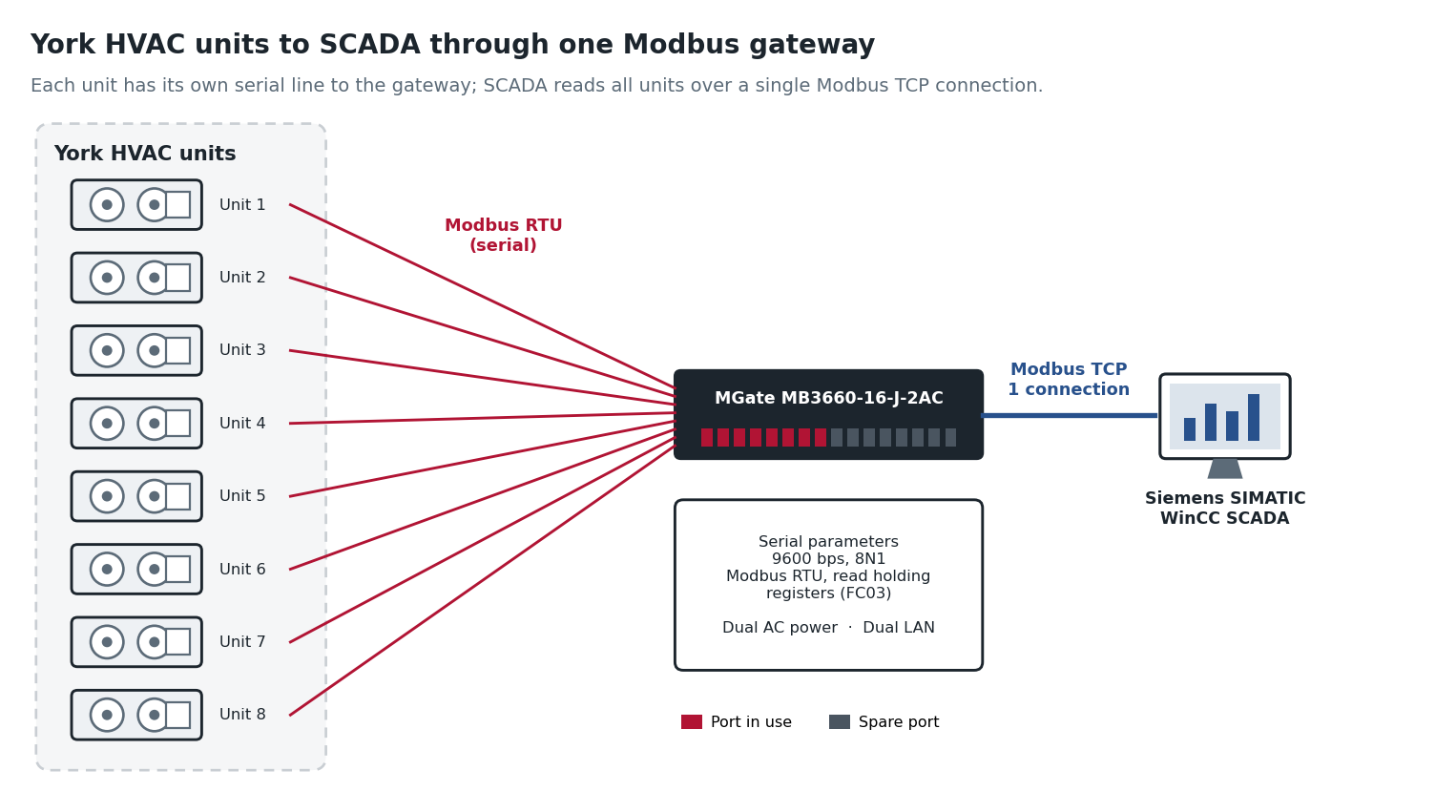
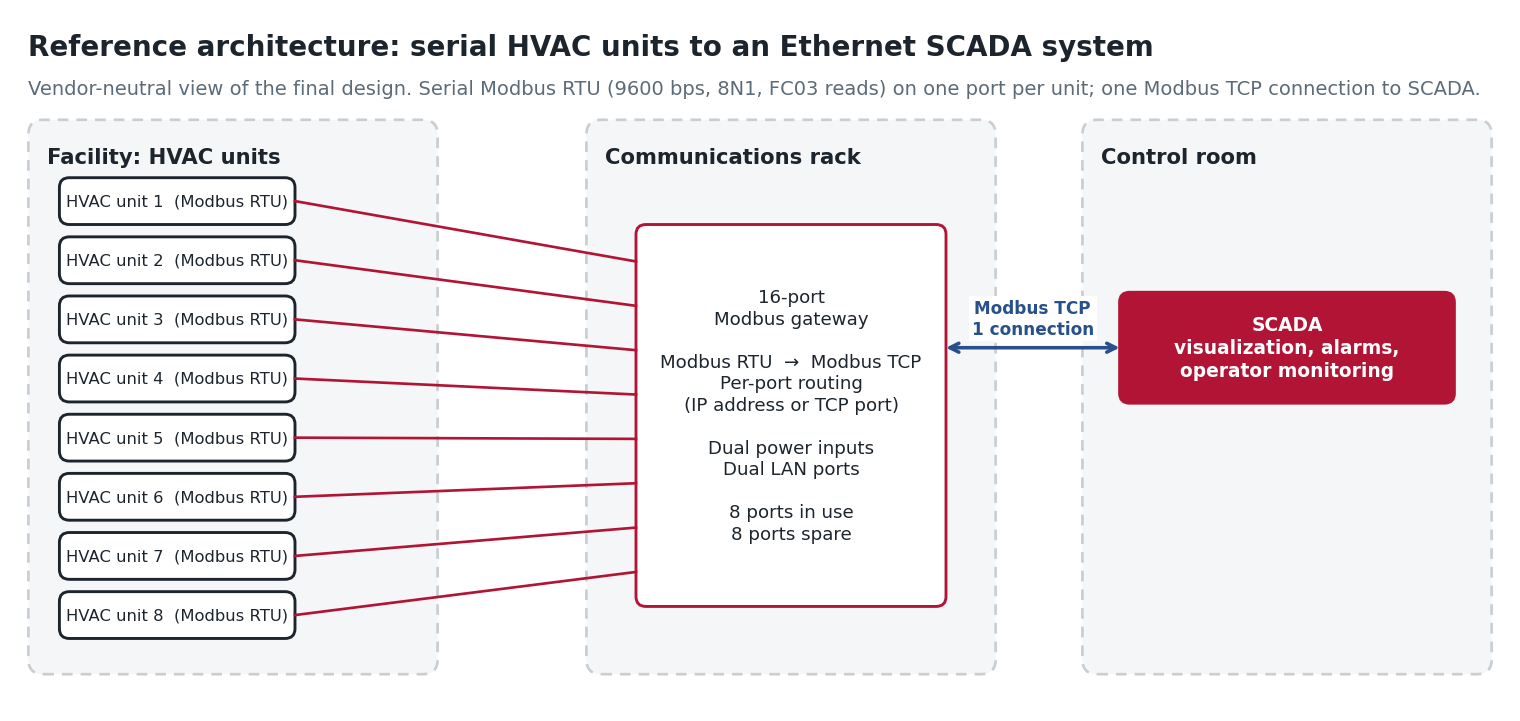
Each York unit connects through its Modbus RTU communication board to its own serial port on the gateway, at 9600 bps with 8 data bits, no parity and 1 stop bit.
Gateway
The Moxa MGate MB3660-16-J-2AC polls the units by reading their holding registers (Modbus function code 03) and converts between Modbus RTU and Modbus TCP.
SCADA
WinCC reads the entire HVAC fleet through a single Modbus TCP connection and uses the data for visualization, alarm handling and operator monitoring.
Integration approach
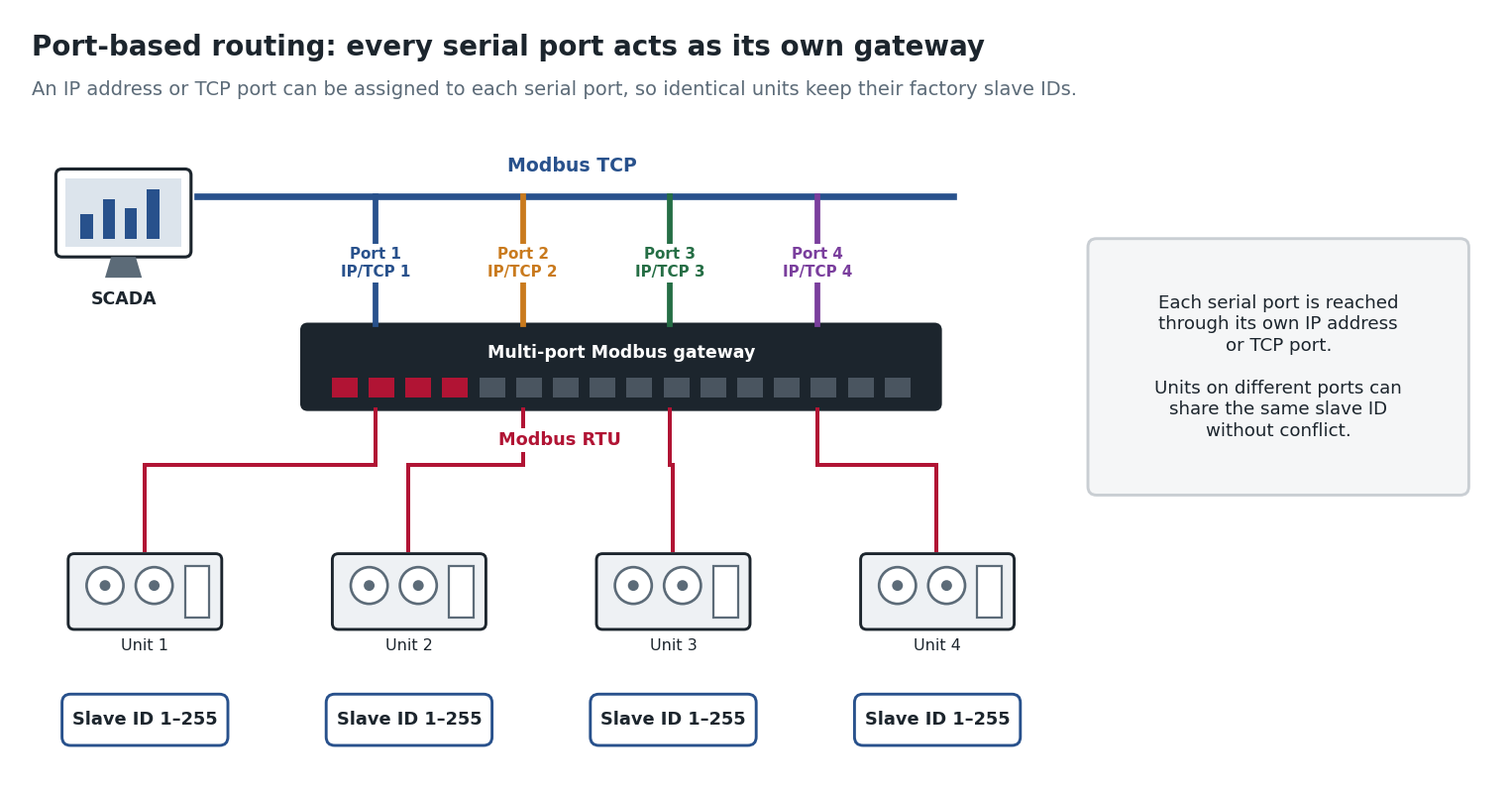
The MB3660 can map an IP address or TCP port to each serial port, so every port behaves like its own gateway with a full slave ID range (1 to 255). Identical York units therefore keep their factory addresses, and WinCC addresses each unit through its port mapping.
Migration and cutover plan
A trial run validated communication with the York units and confirmed that the required monitoring points appeared in WinCC before the full rollout. Because the integration only adds a communication path to the units’ existing Modbus boards, the equipment kept operating under its own controls throughout.
What we reused
- The York HVAC units and their built-in Modbus RTU communication boards, with no unit replacement or controller change
- The existing Siemens SIMATIC WinCC SCADA system, which gained the HVAC data without a new supervisory platform
Security considerations
The integration is built for monitoring: the gateway reads holding registers (FC03) from the units, so SCADA gains visibility of the HVAC fleet without adding control commands to the equipment. Each unit sits on its own serial line, so a faulty device or cable cannot disturb communication with the others, and the HVAC data enters SCADA through one known Ethernet endpoint.
Products and Technologies Used
| Product | Brand | Role in project | Why selected | Alternatives considered |
|---|---|---|---|---|
| MGate MB3660-16-J-2AC | Moxa | Central gateway between the York HVAC units and SCADA | 16 RS-232/422/485 ports (RJ45), Modbus RTU/ASCII to Modbus TCP, per-port routing, dual AC power, dual LAN | Separate integration per unit: rejected, Safran required one integration point |
| York HVAC units | York | Monitored equipment | Modbus RTU communication board exposes status, alarm and operating values | Existing equipment, reused |
| SIMATIC WinCC SCADA | Siemens | Central monitoring, visualization and alarms | Existing site SCADA; reads the HVAC data as a Modbus TCP client | Existing system, reused |
Implementation Process
-
Site assessment
Review of the York HVAC units, their communication interfaces and the WinCC integration requirements.
-
Solution design
Proof of concept with the York units, the MGate MB3660-16-J-2AC and WinCC, followed by a centralized architecture on the 16-port gateway with one serial port per unit.
-
Installation and deployment
Gateway configuration of the serial port settings and mapping of the required HVAC data points for SCADA use.
-
Testing and validation
HVAC status, alarms and operating values brought into SIMATIC WinCC, and end-to-end communication confirmed from each York unit through the gateway to the SCADA interface.
-
Ongoing support
A single gateway gives the maintenance team one place to start troubleshooting and a clear path for adding data points or units later.
Results and Key Benefits
- 8York HVAC units visible in one WinCC interface
- 1Modbus TCP connection instead of a separate integration per unit
- 8Spare serial ports ready for future HVAC equipment
- ReusedExisting York Modbus boards and WinCC kept, with no unit replacement or new SCADA platform
Operators and maintenance staff now see the status and alarms of every York unit in WinCC, so they can identify an issue and respond without first locating the unit and checking it on site. With the architecture proven before rollout, the deployment carried little integration risk, and adding HVAC or other Modbus RTU equipment later means connecting a cable and mapping registers, not redesigning SCADA.
Why This Solution Worked
One port per unit instead of a shared RS-485 line
Daisy-chaining the units would use fewer ports but would force readdressing and let one wiring fault silence several of them. Dedicated ports use more of the gateway but keep each fault contained.
A multi-port gateway instead of per-unit converters
One gateway means one device to configure, back up and monitor, and one connection in SCADA. The trade-off is a single communication point for the fleet, which the MB3660’s dual power inputs and dual LAN ports are designed to protect.
Sized for growth
Sixteen ports for eight units costs more up front than an exact fit, but the next HVAC units can be added without new hardware or a change to the architecture.
Proof of concept before rollout
Confirming communication with the actual York units and the actual WinCC system removed the main integration risk before Safran committed to the full deployment.
Reference Architecture
Related Solutions and Case Studies
Frequently Asked Questions
How did ManuAuto connect serial Modbus RTU HVAC units to an Ethernet-based SCADA system?
With a multi-port Modbus gateway. Each York unit’s Modbus RTU board connects to its own serial port on a Moxa MGate MB3660, which converts the traffic to Modbus TCP. SIMATIC WinCC then reads all eight through a single Ethernet connection, with no changes to the HVAC equipment itself.
Can HVAC units with the same Modbus slave ID share one gateway?
Yes. The MGate MB3660 can route requests by IP address or TCP port, so each serial port behaves like a separate gateway with its own slave ID range from 1 to 255. Identical units can keep their factory addresses instead of being readdressed one by one in the field.
Does this approach work with SCADA platforms other than WinCC?
Yes. The gateway presents the HVAC data as standard Modbus TCP, so any SCADA, HMI or historian that acts as a Modbus TCP client can read it the same way, including Ignition, AVEVA and FactoryTalk. Only the tag mapping on the SCADA side changes; the gateway and wiring stay as they are.
What if the HVAC equipment or building system uses BACnet instead of Modbus?
Then a different gateway is needed, because the MGate MB3660 handles Modbus only. To bring Modbus devices into a BACnet/IP building management system, the Moxa MGate 5217 Series is the usual choice. ManuAuto can review your equipment list and recommend the right conversion path before you buy.