
How Single-Pair Ethernet Is Powering the Next Phase of Industry 4.0

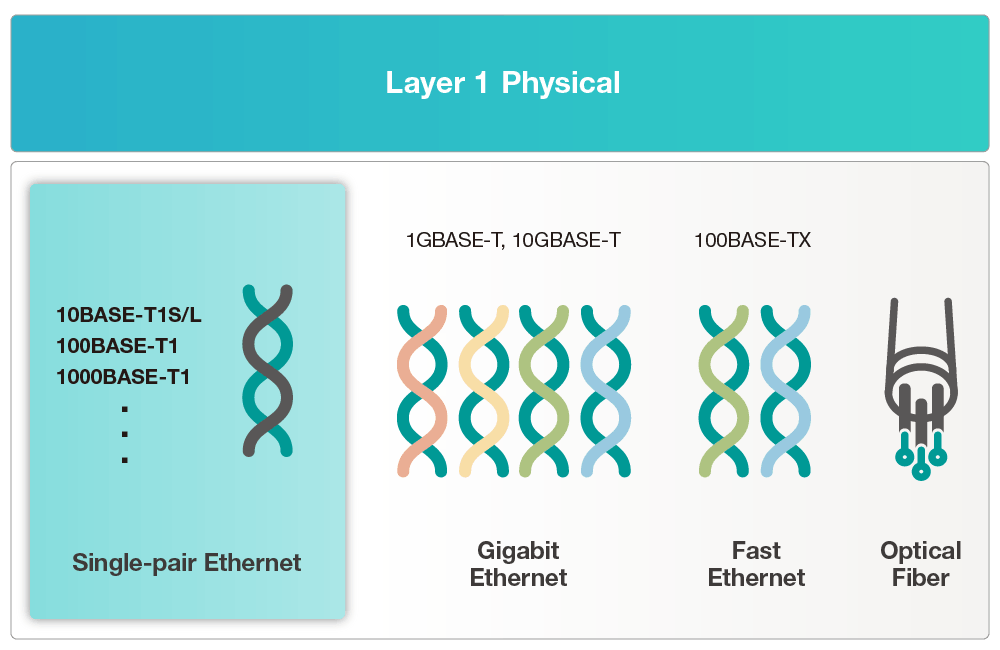
Single Pair Ethernet (SPE) is changing the way industrial networks are cabled, letting a single twisted-pair conductor carry data and power together instead of the multiple copper pairs conventional Ethernet has always needed. That shift at the physical layer trims material costs, shortens commissioning schedules, and removes a real share of the wiring bulk automation projects typically have to plan around.
Built on the IEEE 802.3 family of standards, SPE isn't a single fixed specification, depending on the variant selected, engineers can match the data rate and cable run to the application, connecting field-level sensors and edge devices back to the core industrial network without over-provisioning the cabling.
Moxa's Single Pair Ethernet switch lineup gives system integrators and plant operators a proven, scalable path for bringing that connectivity into existing control architecture, combining a straightforward installation with the long-term reliability industrial sites expect well after commissioning wraps up.
What Single-Pair Ethernet Brings to the Plant Floor
One Cable Pair, Full Ethernet
Moxa's SPE hardware runs on a single twisted-pair cable, so the cabling volume, the material bill, and the installation schedule all shrink together across an industrial automation rollout.
Reach Without Repeaters
Running on the 10BASE-T1L standard, SPE carries a reliable signal out to 1,000 meters, a real advantage on large industrial sites where dependable long-distance connectivity matters more than raw throughput.

Power and Data on One Line
With Power over Data Line (PoDL) built into the standard, SPE moves power and data down the same cable, so dedicated power runs are no longer part of how field devices get installed.
How Single-Pair Ethernet Supports Industry 4.0 Rollouts
Industrial operations are moving fast, and Single Pair Ethernet sits right at the center of that shift, underpinning IIoT adoption and giving digital transformation programs a physical layer that actually reaches the field. By pushing native digital connectivity down to individual devices rather than stopping at the control cabinet, SPE gives industrial network infrastructure more efficiency, more flexibility, and more room to scale as the network grows.
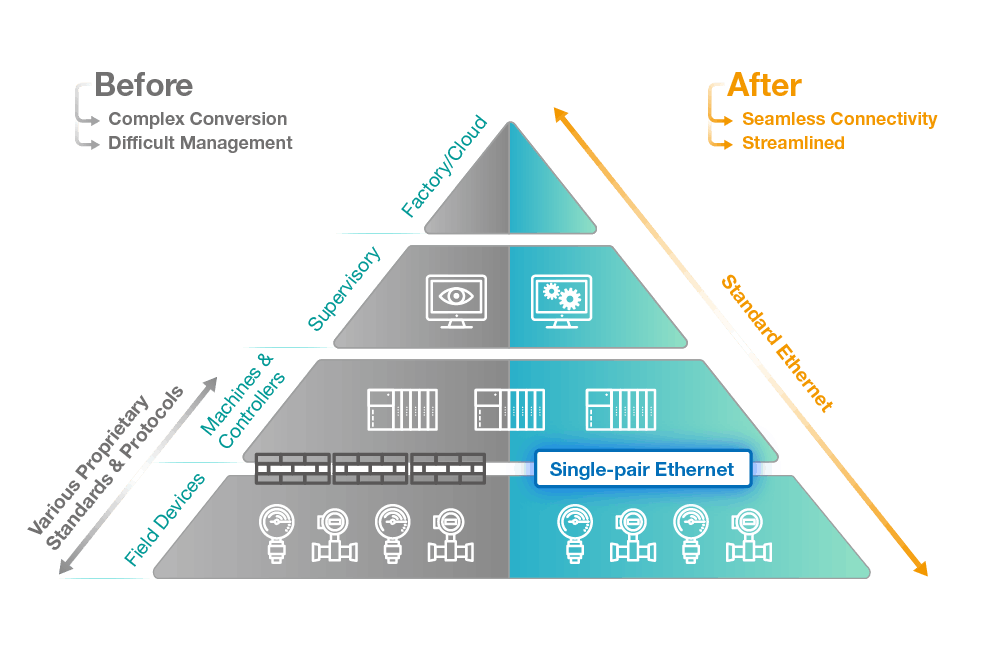
Single Pair Ethernet is quietly doing a lot of the work behind Industry 4.0, extending native Ethernet connectivity out to field-level devices over long runs on nothing more than a single twisted pair. It pulls edge devices into one coherent network, stays compatible across multiple industrial Ethernet protocols, and lays the groundwork for real-time monitoring, predictive maintenance, and data-driven decisions on the plant floor.
Where Single-Pair Ethernet Is Being Deployed Today
As an emerging physical-layer standard, Single Pair Ethernet is changing how industrial networks get built, with measurable gains in reliability, flexibility, and communication efficiency. From tighter process monitoring to leaner control architectures, SPE is already earning its place across a wide range of industrial use cases.

Automotive
Vehicle production lines are under constant pressure from tightening costs, growing vehicle weight, and ever more in-vehicle connectivity to support. Single Pair Ethernet answers that directly, trading heavy wiring harnesses for one lightweight twisted-pair cable that handles both power and high-speed data. The payoff is a lighter cabling architecture, steadier signal reliability, and a more straightforward path to integrating ADAS and autonomous-driving features into upcoming vehicle platforms.

Process Automation
Process automation needs dependable, high-integrity data over long distances, and 10BASE-T1L-based Single Pair Ethernet is built for exactly that, steady connectivity across runs of up to 1,000 meters on a single twisted pair. In hazardous or EMI-heavy plants, correct shielding and grounding practices are still what keeps that performance consistent. Ethernet-APL, a physical layer standard purpose-built for SPE, adds another layer of assurance by meeting strict industrial safety requirements for secure communication in demanding conditions.
Building Automation
Older building automation systems are frequently held back by tangled cabling, limited scalability, fragmented integrations, and inconsistent energy performance. Single Pair Ethernet removes those obstacles by folding HVAC systems, security networks, and distributed IoT sensors and controllers into one edge-to-cloud network. For facility teams pushing toward smarter, more sustainable buildings, SPE offers a simpler foundation that lowers operating costs while sharpening data visibility and system responsiveness.

Factory Automation
Factory floors routinely run into scalability ceilings, integration headaches, and dense, expensive cabling runs. Single Pair Ethernet's compact twisted-pair design cuts through that complexity while still delivering the high-speed, low-latency communication factory equipment depends on. The outcome is dependable real-time monitoring and control that helps hold product quality steady and keeps manufacturers aligned with industry regulatory requirements.
Common Questions About Single-Pair Ethernet
As Single Pair Ethernet adoption picks up pace across industrial sectors, engineers and integrators naturally have questions about what it can do, where it fits, and what it takes to deploy. This section walks through the ones that come up most often.
Single Pair Ethernet (SPE) is a next-generation Ethernet physical-layer technology that carries both data and power on a single twisted-pair cable while supporting communication distances of up to 1,000 meters.
Conventional copper Ethernet typically needs four or eight conductors to hit higher bandwidth, and it's generally capped at cable lengths of around 100 meters.
Because it cuts cabling complexity and installation costs, SPE is the more efficient option for industrial network optimization, while standard Ethernet still holds the edge for bandwidth-heavy enterprise and data center environments.
Industrial fieldbus technologies have kept automation systems running for decades, but they routinely run into trouble with interoperability, scalability, bandwidth ceilings, and IT integration. Single Pair Ethernet gets around those limits by extending standard Ethernet all the way to field devices, which opens the door to protocol flexibility, real-time communication, simpler deployment, and native IIoT connectivity for Industry 4.0 environments.
Hazardous industrial areas hold potentially explosive gases, vapors, or combustible dust, which means the communication equipment installed there needs specific certification to keep operations safe and rule out ignition risks.
Ethernet-APL extends what Single Pair Ethernet can do in exactly these environments. Built on the 10BASE-T1L standard, it delivers both power and data over a reinforced single twisted-pair cable while satisfying strict industrial safety requirements for reliable communication in hazardous locations.
Power over Data Line (PoDL) lets Single Pair Ethernet deliver electrical power and Ethernet communication through the same twisted-pair cable. That cuts wiring requirements, brings installation costs down, shortens deployment time, and frees up cabinet space. PoDL also makes connecting remote field devices easier by removing the need for separate power cabling, which gives industrial edge deployments more room to be flexible and efficient.
Single Pair Ethernet operates at the physical layer, while Time-Sensitive Networking (TSN) works on the higher network layers, adding deterministic features like precise synchronization, scheduled traffic, and guaranteed real-time performance. Put together, SPE and TSN form a strong foundation for end-to-end industrial communication, backing highly reliable, low-latency, and scalable industrial network optimization.
Featured Moxa Single-Pair Ethernet Switch
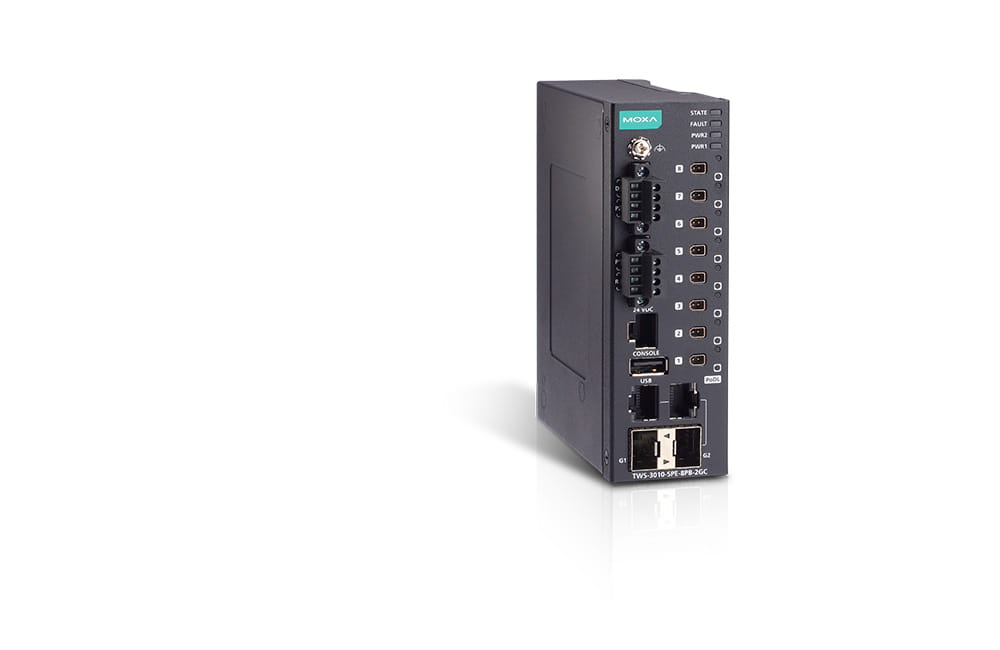
TWS-3010-SPE Series
8 10MbE-SPE, 2 1GbE-port managed Ethernet switches with PoDL
Key Features and Benefits
- Supports 8 Single-Pair Ethernet 802.3cg 10Base-T1L ports
- Delivers PoDL power classes 10, 11, and 12 through the SPE ports
- Compact industrial housing for tight installation spaces
- Supports EtherNet/IP, PROFINET, and Modbus TCP protocols
- Built for reliable edge-to-cloud industrial communication
Related Products

