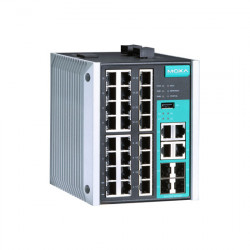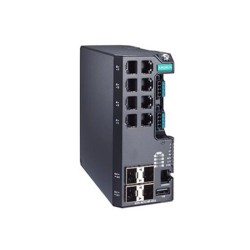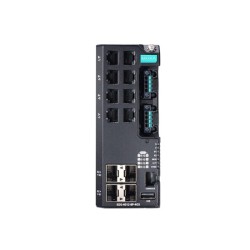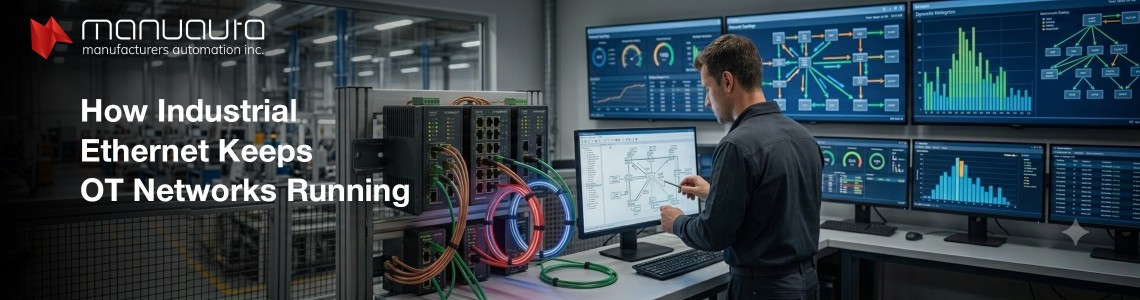
Ethernet switches in OT networks were once considered an IT solution forced into an industrial context. That perception is long gone. Industrial Ethernet has moved from an emerging alternative to the default choice across critical industrial sectors. The shift from legacy fieldbus to Ethernet industrial communication is not a trend. It is the established standard across every critical industrial sector.
This guide covers what industrial Ethernet is, why it replaced serial communication, how redundancy protocols keep OT networks online, and where deterministic communication fits into the modern industrial network stack. Whether designing a new network or upgrading an existing one, this is where to start.
What Is Industrial Ethernet and Why Does It Matter in OT Networks
Standard Ethernet was designed for office environments. It is fast, flexible, and tolerant of occasional packet loss. Industrial Ethernet is a different proposition entirely. It adapts the IEEE 802.3 standard for environments defined by extreme temperatures, electromagnetic interference, vibration, shock, and zero tolerance for communication failure.
Three characteristics separate industrial Ethernet from its commercial counterpart:
- Durability: hardware rated for operating temperatures from -40°C to 75°C, wide voltage input ranges, and protection against EMI and electrical transients.
- Determinism: guaranteed message delivery within a defined time window, critical for process control, motion control, and safety systems.
- Redundancy: ring topologies with failover protocols that restore communication in under 10 milliseconds when a link fails.
Ransomware attacks targeting OT networks have continued to climb year over year, underscoring why industrial network reliability and security have become inseparable requirements in modern OT network design.
Industrial Ethernet
Industrial Ethernet is Ethernet technology specifically designed for industrial and Operational Technology (OT) environments such as factories, power plants, transportation systems, and oil & gas facilities. It provides deterministic communication, high reliability, redundancy, extended temperature operation, resistance to vibration and electromagnetic interference (EMI), and support for industrial protocols such as Modbus TCP, PROFINET, EtherNet/IP, and OPC UA.
Commercial Ethernet
Commercial Ethernet is standard Ethernet used in office, enterprise, and IT environments. It is designed for general data communication, internet access, and business applications where extreme reliability, environmental resistance, and real-time performance are typically not required.
| Characteristic | Commercial Ethernet | Industrial Ethernet |
|---|---|---|
| Primary use | IT and office networks | OT and industrial automation |
| Environment | Climate-controlled, 0°–40°C | Harsh, −40°–75°C |
| Enclosure rating | Standard | IP30 to IP67 |
| Redundancy support | Limited | RSTP, MRP, PRP, HSR |
| Mean time between failures | 100,000 hrs | 500,000+ hrs |
| EMI protection | Standard | High immunity |
| Typical lifespan | 3–5 years | 10–20 years |
| Protocol support | Standard TCP/IP | PROFINET, EtherNet/IP, Modbus TCP |
Why can't standard commercial Ethernet switches be used in industrial OT environments?
Commercial switches are designed for climate-controlled environments with stable power, minimal vibration, and standard temperature ranges. Industrial OT environments expose networking hardware to wide temperature swings, electromagnetic interference, power fluctuations, and continuous vibration. Beyond the physical environment, industrial Ethernet switches support redundancy protocols, including RSTP and MRP, and industrial communication protocols, including PROFINET, EtherNet/IP, and Modbus TCP, that commercial switches do not. Using commercial hardware in an OT environment is not a cost optimization. It is a reliability risk.
Implementing a reliable industrial Ethernet infrastructure requires careful network planning and architecture design from the outset, not as a retrofit. For a broader understanding of OT system design principles, see our Complete Guide to Industrial Network Architecture in OT Systems.
Core Engineering Decisions in Industrial Ethernet Design
Not every switch selection or redundancy choice in an OT network carries the same weight. These four decisions determine whether a network performs reliably under real production load or only looks correct on paper.
Managed vs Unmanaged Industrial Ethernet Switches
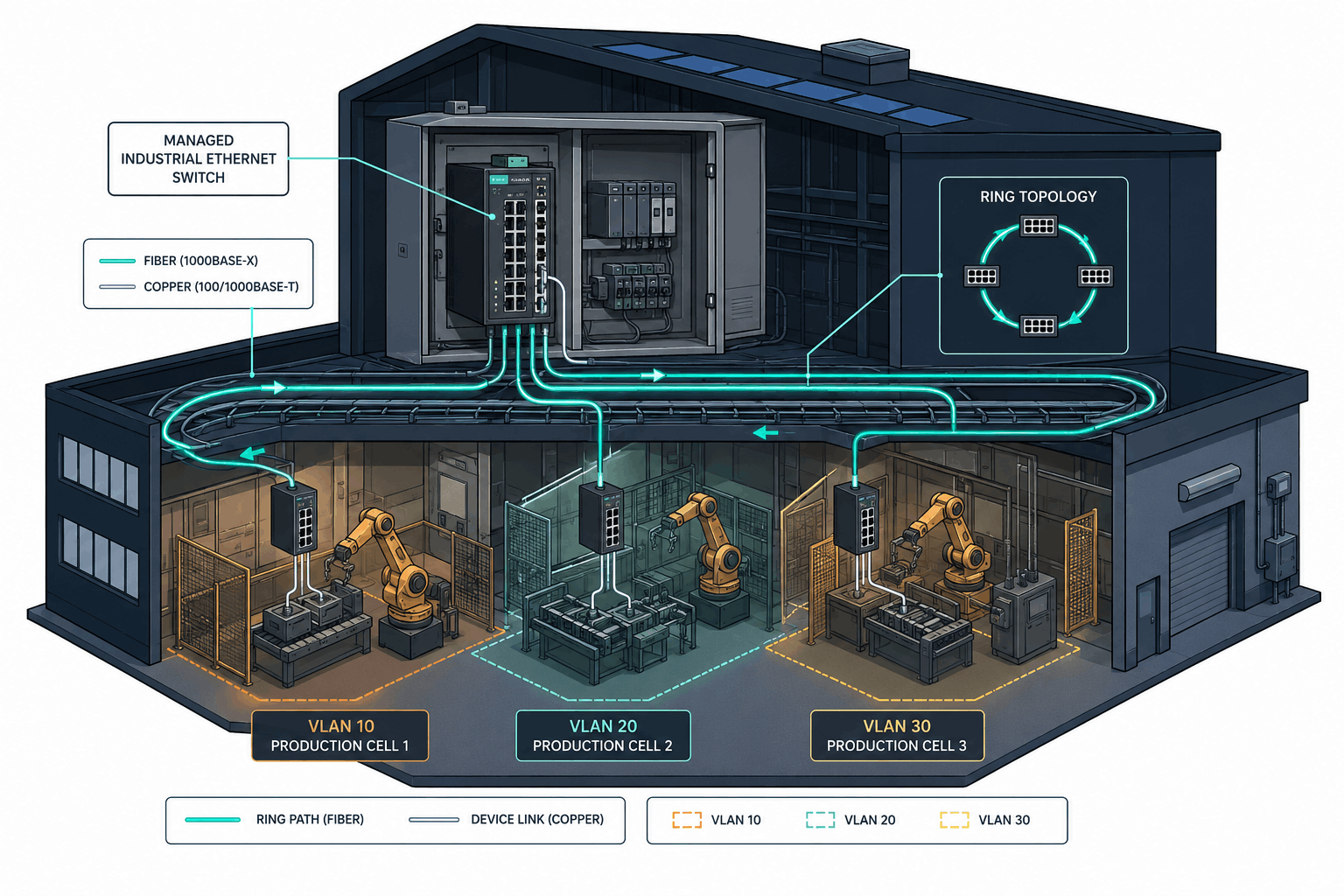
Not every switch in an OT network needs full management capability. But the wrong choice at the wrong layer creates visibility gaps and segmentation failures that are difficult to diagnose and expensive to fix. Unmanaged switches offer plug-and-play simplicity for non-critical field-level connections. Managed switches provide VLAN segmentation, QoS prioritization, full diagnostics, and redundancy protocol support for process control and supervisory network layers. The decision between them is architectural, not financial.
VLAN segmentation on managed switches is also a core network security control, not just a traffic-management feature; see our guide to OT Cybersecurity in Industrial Networks for how segmentation fits into a defensible OT security architecture.
Network Redundancy in Industrial Ethernet: RSTP and MRP
A single link failure in a non-redundant industrial network stops communication. In a production facility, that means a stopped line. In a power substation, it means lost visibility over an entire distribution zone. Network redundancy in industrial Ethernet, implemented through ring topologies and failover protocols, ensures that link failures are recovered automatically, within defined time windows, without operator intervention. RSTP industrial networks recover in under 200 milliseconds. MRP industrial networks recover in under 10 milliseconds. PRP and HSR, used in power utility and substation automation, provide zero-interruption failover with no measurable recovery time at all. Choosing between them depends entirely on what the connected process can tolerate.
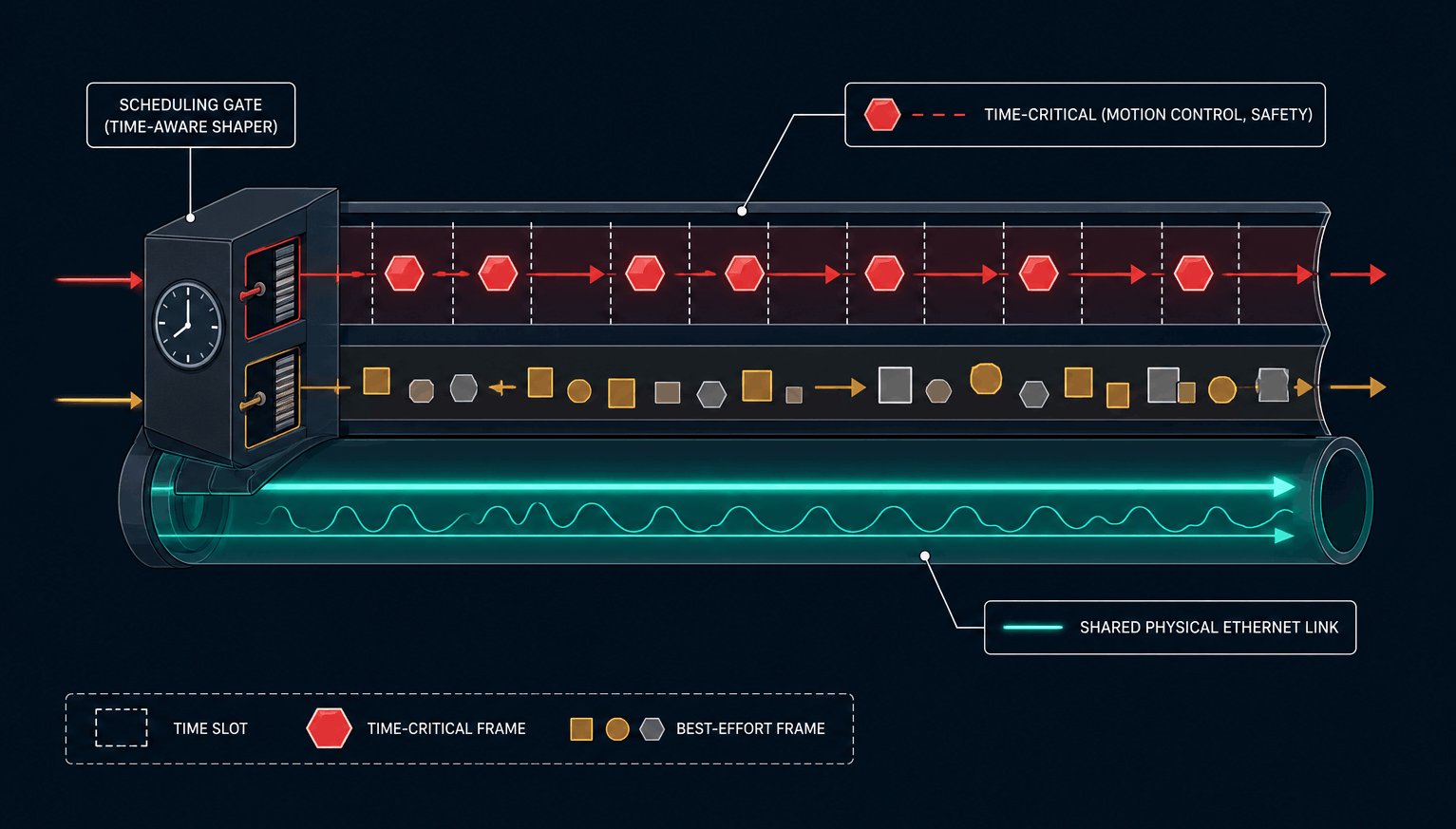
Deterministic Communication and Time-Sensitive Networking (TSN)
Most data traffic tolerates variable latency. Control traffic in a motion system, a robotic cell, or a safety-critical process does not. Deterministic communication (guaranteed message delivery within a fixed time window) is the requirement that separates process control networking from general data networking. Time-Sensitive Networking extends determinism to standard Ethernet, enabling control traffic and standard data to share the same physical network without interference. TSN guarantees deterministic latency and sub-microsecond jitter, allowing real-time control traffic to coexist with normal data on standard Ethernet. As a result, it enables motion control, AI-assisted analytics, and safety-critical processes to run on the same physical infrastructure that also carries routine IIoT traffic.
Network Failover Systems in Industrial OT
Redundancy is the design. Failover is what actually happens when something goes wrong. A well-designed network failover system is invisible: the process keeps running, the operator sees nothing, and the event is logged for later review. A poorly designed one recovers slowly enough to trigger safety shutdowns, alarm cascades, or production stoppages. Understanding how failover behaves under real failure conditions, not just in lab testing, is what separates a resilient industrial network from one that only looks resilient on paper. A deterministic, low-latency Ethernet backbone is also the foundation that real-time edge analytics depends on; see Industrial Edge Computing in OT Networks for how PLC-to-cloud architectures depend on the network layer covered here.
Industrial Ethernet Applications by Industry
Industrial Ethernet is the communication backbone across the most demanding operational environments in the world. The certification requirements, redundancy needs, and dominant protocols differ by sector, but the underlying engineering discipline- deterministic, redundant, environmentally hardened communication- does not.
| Industry | Critical Certification | Redundancy Requirement | Primary Protocol | Key Challenge |
|---|---|---|---|---|
| Manufacturing | EN 61000 EMC | MRP under 10 ms | PROFINET, EtherNet/IP | Deterministic motion control |
| Energy and Power | IEC 61850-3 | PRP / HSR zero recovery | IEC 61850, Modbus TCP | Substation communication |
| Oil and Gas | ATEX, Class 1 Div 2 | Redundant ring | Modbus TCP, OPC UA | Hazardous environment hardware |
| Railway | EN 50155 | Redundant ring | DNP3, MQTT | Wide temperature, vibration |
| Water and Wastewater | AWWA cybersecurity | Cellular failover | Modbus TCP, DNP3 | Remote distributed assets |
Industrial Ethernet in a Manufacturing Environment
A discrete manufacturing facility operating 47 production cells across three interconnected network segments was running on a flat, unmanaged network architecture. Every device, including PLCs, HMIs, vision systems, and robotic controllers, shared the same network segment with no traffic segregation between them. Legacy spanning tree protocol meant that a single link failure took the network 8 to 23 seconds to recover, long enough to trigger emergency shutdowns and interrupt production. As downtime increased and root cause investigation became difficult, network-wide broadcast storms had become a recurring issue. Replacing the unmanaged switches with managed Industrial Ethernet switches addressed all three gaps at once. VLANs separated process control traffic from supervisory and IIoT data streams, so a broadcast storm on one no longer touched the others. MRP ring failover replaced spanning tree, cutting recovery time from 8–23 seconds down to under 10 milliseconds. Fiber uplinks between buildings removed the copper distance limitations that had been causing intermittent link failures. Within six weeks of deployment, network-related emergency stops dropped to zero on control traffic, and the facility subsequently added 23 additional IoT devices to the network with no measurable impact on control traffic latency.
Frequently Asked Questions
What is the difference between RSTP and MRP in industrial Ethernet networks?
Both RSTP and MRP are redundancy protocols for ring-topology industrial Ethernet networks, but they serve different operational requirements. RSTP is an IEEE standard protocol with recovery times under 200 milliseconds, appropriate for supervisory-level networks where brief communication gaps are acceptable. MRP uses IEC 62439-2 and recovers in under 10 milliseconds, designed for process control rings where a 200-millisecond gap is long enough to trigger a safety shutdown or a motion control error. The choice between them is determined by what the connected process can tolerate, not by preference or cost.
What redundancy protocol should be used in an industrial OT network?
The answer depends on the recovery time the connected process can tolerate. RSTP recovers in under 200 milliseconds, appropriate for supervisory networks. MRP recovers in under 10 milliseconds, required for process control rings. For power utility applications requiring zero-interruption failover, PRP and HSR provide seamless redundancy with no recovery time at all. A network designed with the wrong redundancy protocol for its application will fail when it is needed most: not in testing, but in production.
Why is deterministic communication important in OT networks?
Deterministic communication guarantees that a message sent at a specific time arrives within a defined window, regardless of overall network traffic load. In office IT networks, variable latency is imperceptible. In a motion control system coordinating servo drives, a few milliseconds of unexpected delay causes mechanical errors. In a safety system, it can delay a shutdown command. Ethernet industrial communication in OT environments must be engineered for determinism at the process control layer, which is why TSN, PROFINET IRT, and EtherNet/IP CIP Sync exist as distinct capabilities within the broader Ethernet standard.
Industrial edge devices often collect data from machines using protocols such as Modbus TCP, OPC UA, and MQTT before processing information locally. Our guide to Industrial Communication Protocols in OT Networks explains how these protocols structure data exchange, ensure interoperability between different vendors, and enable reliable communication between field devices, controllers, and edge platforms in OT environments.
Ready to Build a More Reliable Industrial Network
Network failures in OT environments are not IT problems. They are operational events with real production, safety, and financial consequences. The right industrial Ethernet architecture, correctly specified, properly deployed, and backed by engineering expertise, eliminates the vast majority of network-related operational interruptions before they happen.
Manuauto supplies and supports the full range of industrial Ethernet switching, redundancy, and fiber connectivity solutions across Canada and North America with pre-sales engineering consultation, fast distribution, and a price match guarantee on every order.